The Voynich Manuscript: The Book No One Can Read
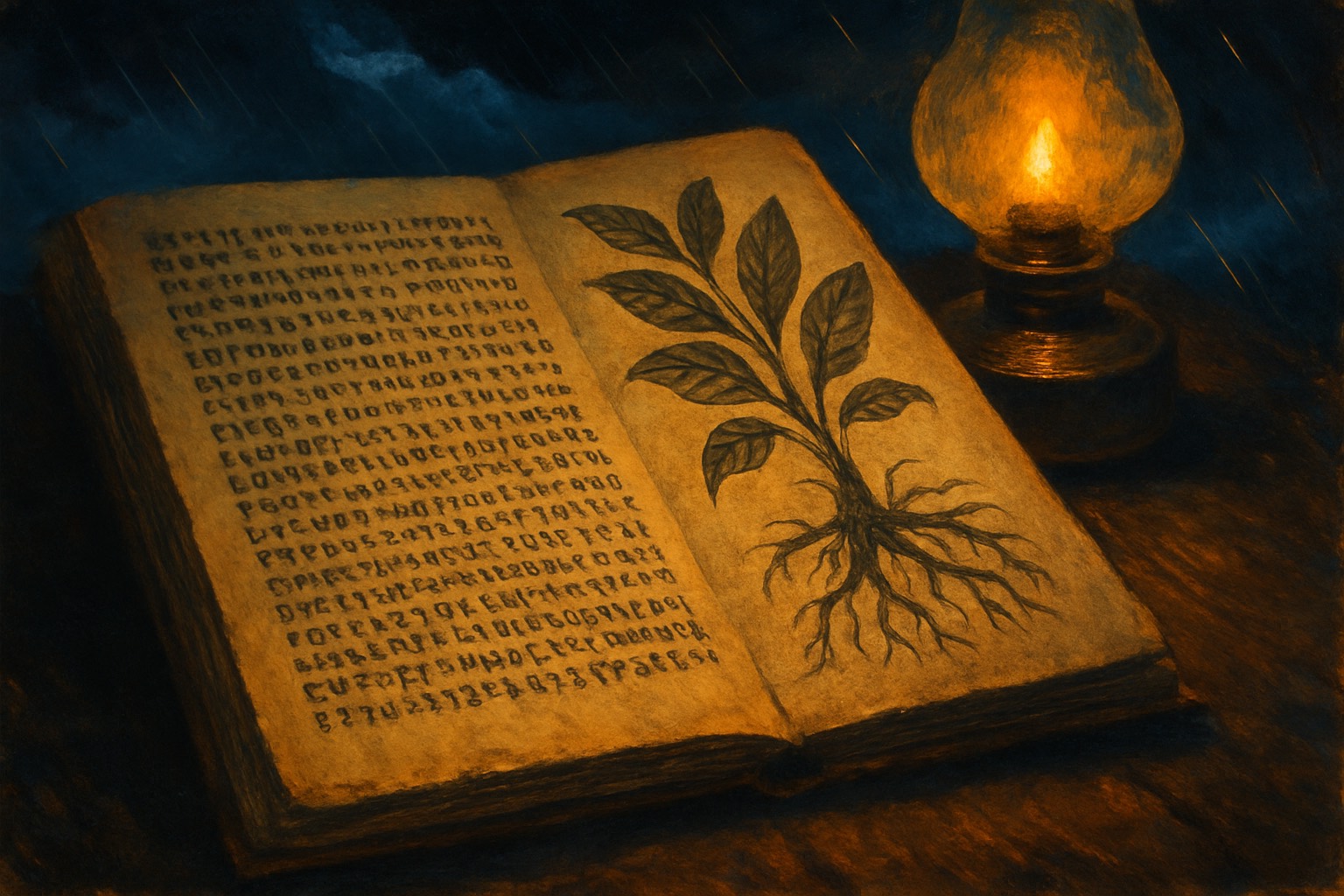
There is a book in a climate-controlled room at Yale University that no living person can read. Not because the language is lost — lost languages get recovered. This one has never been read by anyone, in any era, that we can prove. It is roughly 600 years old, written in a confident, flowing hand by someone who clearly knew exactly what they were saying. And in six centuries, across cryptographers, linguists, codebreakers from two world wars, and now machine-learning models trained on every language humans have ever recorded, not one person has cracked a single sentence.
The Mystery
The manuscript is catalogued, unglamorously, as Beinecke MS 408. It sits in the Beinecke Rare Book and Manuscript Library at Yale, where it was deposited in 1969. It is about the size of a modern paperback, roughly 240 surviving pages of vellum — calfskin parchment — bound and illustrated and filled cover to cover with a writing system that appears nowhere else on Earth. Researchers call it Voynichese, after the man who bought the thing in 1912 and made it famous.
Here is what makes it more than a curiosity. The script is not random scribbling. It behaves like a real language. The text follows internal rules. Certain words — one transliterated as daiin recurs constantly — appear with the kind of frequency you'd expect from a functioning grammar. Word lengths cluster predictably. There are statistical regularities in how the characters combine that mirror natural human languages, not the flat noise of someone faking it. Whoever wrote this was following a system in their head, page after page, without hesitation marks or corrections. That is the cruel part of the puzzle: it looks completely legible, and it is completely opaque.
The illustrations only deepen the strangeness. Scholars have sorted the book into roughly six sections, each with its own visual grammar. The largest is botanical — over a hundred plants, painted in detail, almost none of which match any species that has ever grown anywhere. Some seem to fuse the roots of one plant with the leaves of another; others look plausible until you try to identify them and realize you can't. There is an astronomical and astrological section of suns, moons, and star diagrams, with circular charts and zodiac-like figures whose constellations no astronomer recognizes. There is a cosmological section of foldout pages and strange interlocking circles. Strangest of all is the balneological section: nude women standing in green and blue pools connected by elaborate tubes and pipes, like a Renaissance dream of plumbing. Then come pages of jars and labeled herb fragments — a pharmaceutical catalog of some kind — and finally a section of short paragraphs, each tagged with a star in the margin, that look for all the world like recipes for something we will never know the name of.
It reads, in other words, like a working reference book. A physician's manual, a herbalist's compendium, a treatise on the body and the heavens — the kind of practical volume an educated person in the fifteenth century might actually own and use. Everything about its structure says this was meant to be consulted. Everything about its script says good luck.
The Hunt
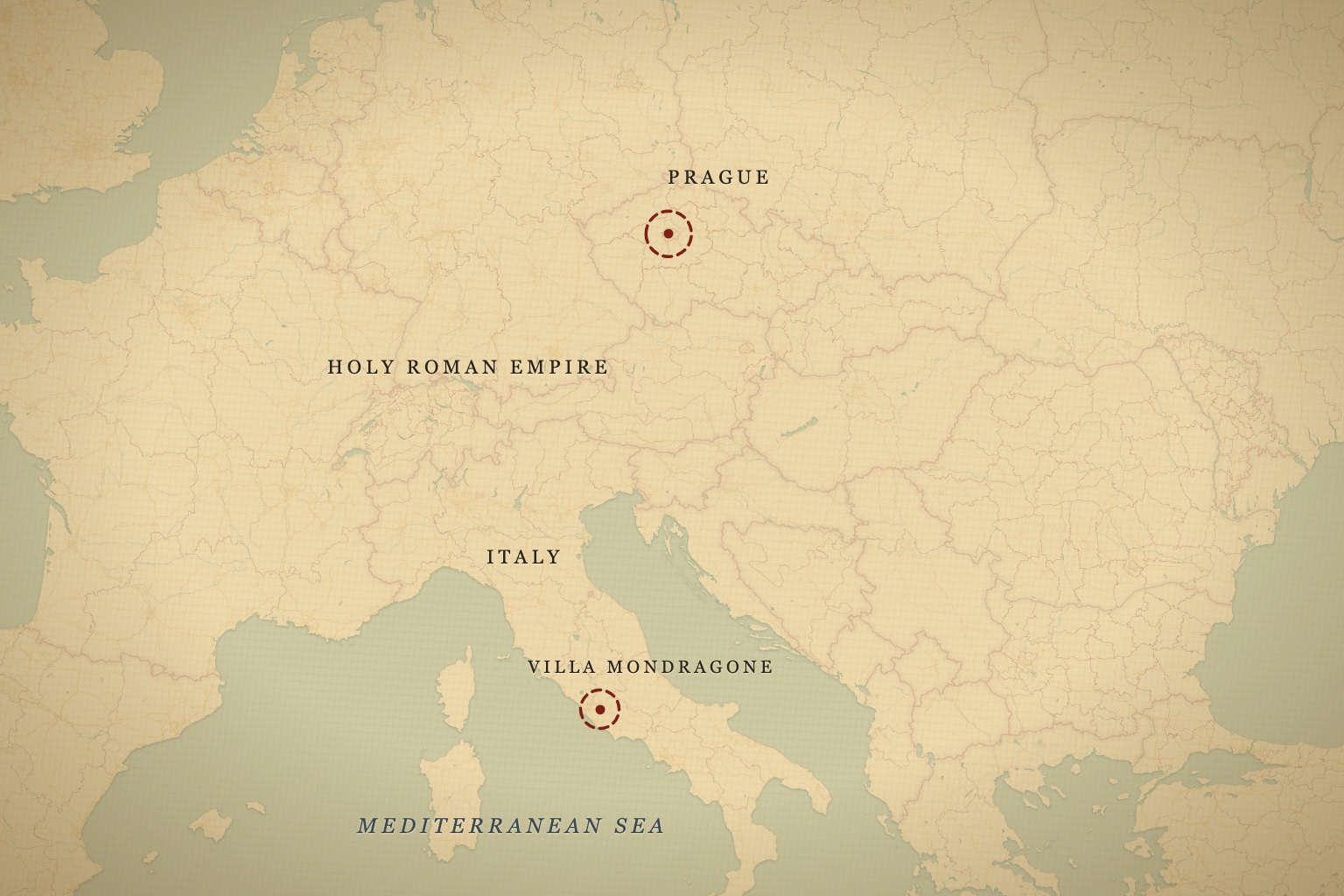
The modern chase began in 1912, when a rare-book dealer named Wilfrid Voynich acquired the manuscript from a Jesuit college near Frascati, Italy, as part of a larger collection. Voynich — for whom the book is now named — spent the rest of his life trying to establish what it was and who wrote it, and died in 1930 without an answer.
Tucked inside the pages he found a letter, dated to the 1660s, from Johannes Marcus Marci, a physician and rector at Charles University in Prague. Marci was sending the book to a famous Jesuit scholar in Rome, Athanasius Kircher, who was renowned in his day as a man who could decode anything. The letter passed along a claim that the manuscript had once been purchased by Holy Roman Emperor Rudolf II for the staggering sum of 600 gold ducats — an emperor's ransom for a book nobody could read. Kircher, the great decipherer, apparently got nowhere with it either. That is the recurring pattern of this file: the most qualified person in every century takes a swing and misses.
The twentieth century brought professional codebreakers into the room. The most consequential attempts came from people who had broken real ciphers under real pressure — military cryptanalysts, including some who had worked on enemy codes during the world wars. They applied the full toolkit: frequency analysis, pattern matching, the hard mathematics that had cracked wartime encryption. The Voynich text defeated all of it. Crucially, the statistical fingerprint of the script does not match what a simple substitution cipher or a polyalphabetic cipher would produce. If it's a code, it is not any of the codes we know how to break.
Modern analysis has added its own wrinkles. Researchers noticed that the manuscript appears to be written in at least two subtly different "hands" or styles of the same script — labeled Currier A and Currier B after the cryptanalyst who first separated them — as if more than one scribe, or one scribe in two modes, produced the text. The character set itself is small and tightly controlled; the same couple dozen symbols recur throughout, combined according to rules that feel native rather than improvised. And in the age of computers, the manuscript has been fed into the same statistical and machine-learning methods that translate and model human languages. Those tools can tell you the text is structured. They have not been able to tell you what it means.
The manuscript has pulled television into the room as well: Discovery's Expedition Files gave it a segment in "Code Breakers" (Season 1, December 2024), Josh Gates walking the same corridor of dead ends the professionals know by heart. The failure record now spans wartime cryptanalysts, statistical linguists, machine-learning models, and cable television — a kind of democracy of defeat the book seems to enforce on everyone who opens it.
What History Says
So scholars are left with a short list of possibilities, none of them clean.
It could be an encoded version of a real language, written with some encryption scheme so unusual that six centuries of cryptography haven't reverse-engineered it. It could be a constructed language — an invented tongue with its own internal logic, the way a few medieval and early-modern thinkers tried to build "universal" languages from scratch. It could be a natural language written in an unfamiliar script, possibly one we'd recognize if we knew the rules. And there has always been the deflating possibility that it is an elaborate hoax — beautiful, expensive nonsense produced to dazzle a buyer like Rudolf II. But the experts who study it tend to push back hard on the hoax theory, precisely because the text is too consistent. Gibberish written by hand drifts and repeats in tells that this manuscript doesn't show.
The single most important piece of evidence we do have is physical, not linguistic. In 2009, researchers at the University of Arizona radiocarbon-dated the vellum and placed its creation in the early fifteenth century — between roughly 1404 and 1438. Analysis of the inks was consistent with that same period. That date matters enormously. It rules out the most tempting modern explanation, the idea that Wilfrid Voynich or some Victorian forger faked the whole thing on salvaged old parchment to make a sale. The animal that became this book's pages was alive 600 years ago, and the writing went down not long after. Whatever this is, it is genuinely medieval.
That fact closes one door and leaves every other door wide open. We know when. We do not know who, where, why, or what it says.
The Verdict
Plenty of researchers have announced solutions. None has held up under scrutiny. Every few years a paper or a press release claims the Voynich Manuscript has finally been read — an obscure dialect, a forgotten shorthand, a key that unlocks the lot — and every time, the wider community of scholars examines the claim and finds it doesn't actually decode the text in any repeatable way. The book has a long history of breaking the people who think they've beaten it.
What's left is genuinely unresolved, in the strictest sense of the word. We have a real fifteenth-century object, written by a real and competent hand, in a real and rule-governed script, that no human being has demonstrably read since it was made. The plants don't exist. The stars are wrong. The women stand in their impossible pools. And the words — thousands of them, patient and legible and utterly silent — are still waiting.
You can see it for yourself. Yale's Beinecke Library has photographed every page and put the entire manuscript online in high resolution, free, for anyone who wants to stare at it. That is, in a way, the most honest move the keepers of this mystery could make: here is the whole thing, every page, nothing hidden. Six centuries of the smartest readers alive haven't cracked it. The file is open. Maybe you'll be the one.
Explore the sites mentioned in this post on the interactive map.
Open the Tracker