The Tunguska Event: The Blast That Flattened a Forest and Left No Crater
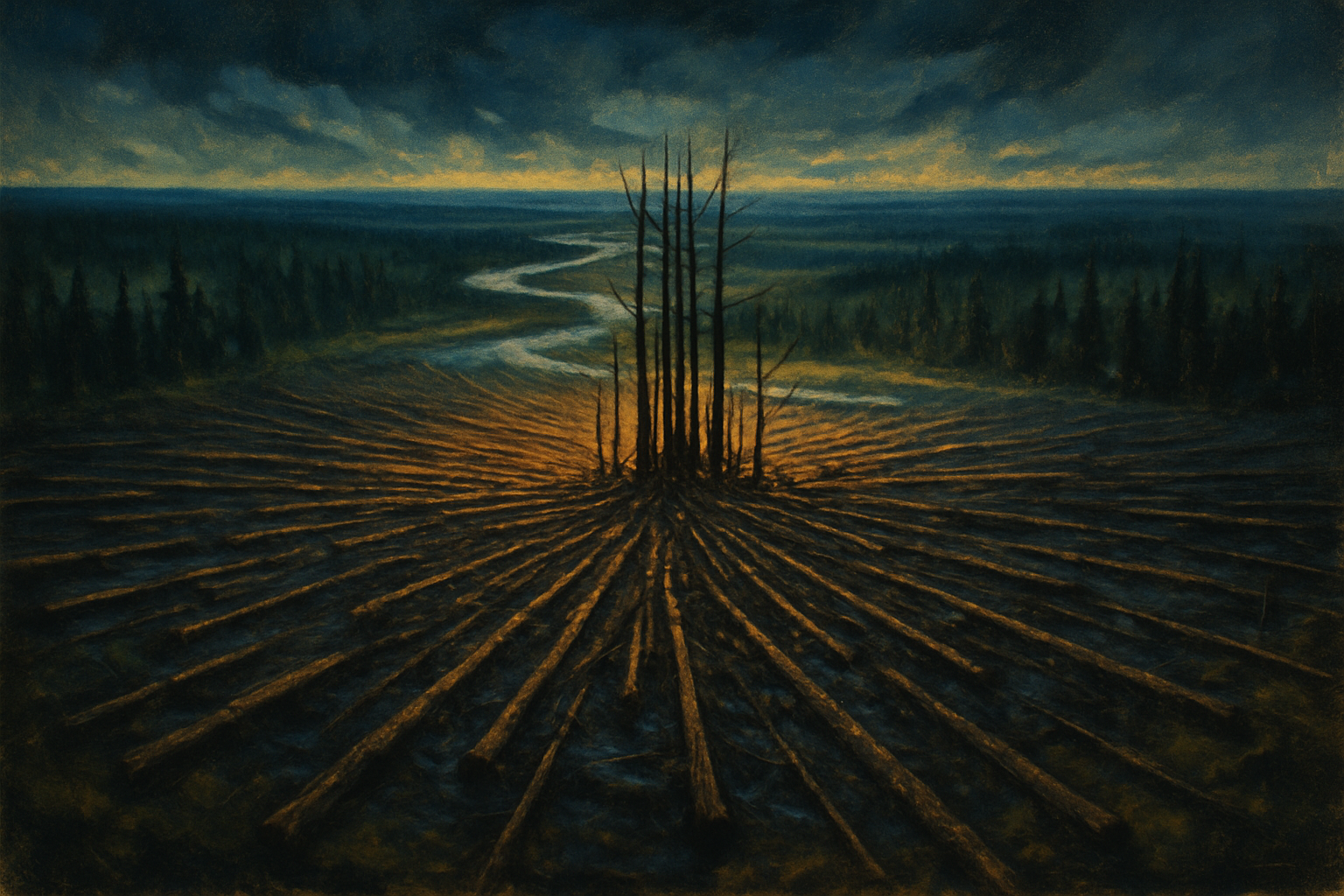
The eyewitnesses closest to it saw the sky split open before they heard anything.
On the morning of June 30, 1908, a fireball brighter than the sun tore across the sky over the sparsely populated taiga of central Siberia and exploded several miles above the ground near the Podkamennaya Tunguska River. The blast flattened an estimated 80 million trees across roughly 2,150 square kilometers — some 830 square miles — snapping them off at the root and laying them out in a vast radial pattern, all pointing away from a single central point. The shockwave knocked people off their feet hundreds of kilometers away, shattered windows, and registered on barometers as far as Britain. It is the largest impact event in recorded human history, and yet more than a century of expeditions has never found the one thing a cosmic collision is supposed to leave behind: a crater.
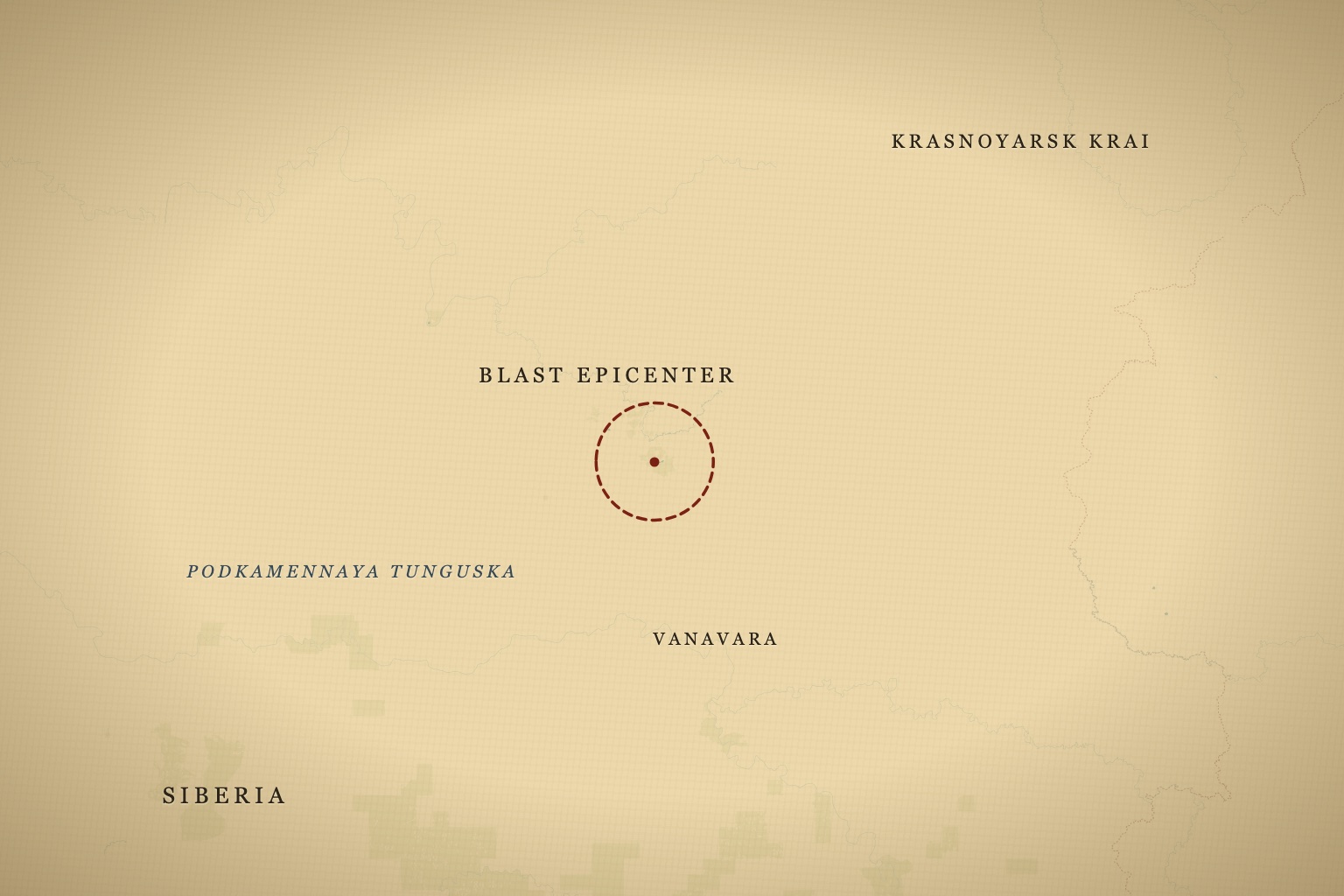
The Location
The epicenter sits in one of the emptiest places on Earth: the boggy, mosquito-thick evergreen forest of Krasnoyarsk Krai, in central Siberia, along the Podkamennaya Tunguska — the "Stony Tunguska" — River. The nearest settlement of any size at the time was the small trading post of Vanavara, roughly 65 kilometers to the southeast, where the Evenki reindeer herders and a handful of Russian traders felt the blast most directly. This is a landscape of permafrost, black rivers, and horizon-to-horizon larch and pine, reachable in 1908 only by river and reindeer sled, and not much more accessible today.
The human accounts that survive come mostly from those Evenki herders and Vanavara traders, and they read like descriptions of the end of the world. One trader, seated on his porch in Vanavara at the moment of the blast, later described the sky in the north seeming to split in two and a wall of fire appearing above the forest, followed by a heat so intense he felt his shirt was burning. He was thrown from his seat by the concussion that arrived moments later, and the ground shook as a series of deafening booms rolled across the taiga. Evenki families camped far closer to the epicenter told of tents being lifted into the air, reindeer scattering and dying, and forest storehouses being incinerated. That these testimonies survived at all is a small miracle of timing and geography.
That remoteness is central to the whole story. Had the object arrived a few hours later, the Earth's rotation would have placed the blast over St. Petersburg or a European capital, and 1908 would be remembered as the year a city vanished. Instead it detonated over taiga so thinly populated that no confirmed human death was ever documented, and so hard to reach that the first scientific expedition would not arrive until nineteen years after the event. The region's very inaccessibility, which spared human life, also delayed investigation until much of the immediate physical evidence had begun to weather away, and it hardened the mystery into legend before science could get a proper look.
The Hunt
Tunguska is the kind of case that draws serious field investigators precisely because the evidence is so real and the conclusion so incomplete. The central puzzle — an explosion of nuclear scale with no crater and no clearly identified body — has pulled scientists, adventurers, and television expeditions into the taiga for over a century, all chasing the same question: what actually hit, and where did it go?
The foundational fieldwork belongs to the Russian mineralogist Leonid Kulik, who became convinced the event was a meteorite fall and lobbied the Soviet Academy of Sciences for years to fund a search. Kulik had first encountered scattered newspaper reports of the 1908 event years after the fact, and the idea of a massive intact iron meteorite — a scientific and even industrial prize — drove his persistence. He finally reached the region in 1927 and stood at the edge of the devastation zone — a wasteland of scorched, felled trees stretching to the horizon. The journey itself was punishing: he traveled by rail to the end of the line, then by horse and on foot through spring mud and swarming insects, relying on reluctant Evenki guides who considered the blast site cursed ground and were wary of leading outsiders into it.
Kulik expected to find a massive impact crater at the center. Instead he found something stranger: at the epicenter, the trees still stood upright, stripped of their branches and bark like a forest of telegraph poles, while everything around them lay flattened and pointing outward. That pattern — standing trees at ground zero, radial devastation beyond — is the signature of an airburst, a detonation in the atmosphere rather than an impact on the surface. It was the same configuration later recognized in the aftermath of the atomic bombings, where structures directly beneath the blast survived comparatively upright while everything at an angle was blown flat. Kulik, working decades before that comparison existed, could only record what he saw and puzzle over it. He photographed the felled trees, mapped the radial pattern, and used it to triangulate toward the center — an early piece of forensic reasoning that later researchers would refine but never overturn.
Kulik dug and drilled for years across multiple expeditions into the 1930s, searching bogs he thought might be craters, and never recovered a meaningful meteorite fragment. He fixed his hopes on a cluster of small pits in the marshy ground, convinced they were secondary impact holes, and had them drained and excavated — only to find old tree stumps and ordinary peat at the bottom. His work was cut short by wider events; he joined the militia during the Second World War, was captured, and died as a prisoner in 1942, his central question unanswered. Later expeditions kept coming: Soviet scientific teams through the mid-twentieth century, international researchers after the Cold War, and modern documentary investigations retracing Kulik's route to Vanavara and beyond. Each has confronted the same maddening arithmetic — a blast estimated at anywhere from 3 to 30 megatons, and almost nothing physical to show for it.
The blast has had a long screen afterlife, too — from Leonard Nimoy's In Search Of... ("Siberian Fireball," 1978), which leaned into the era's nuclear-comparison speculation, to PBS's NOVA "Meteor Strike" (2013), produced after the Chelyabinsk fireball injured more than a thousand people in Russia and made Tunguska feel less like history than a rehearsal.
What History Says
The scientific consensus, built up over decades of fieldwork and modeling, is that Tunguska was an airburst caused by a cosmic object — most likely a stony asteroid or a comet fragment — that exploded roughly 5 to 10 kilometers above the surface. As the body plunged into the atmosphere at tens of kilometers per second, aerodynamic pressure and heat caused it to fragment and vaporize catastrophically in mid-air, releasing its energy as a downward-focused blast. That mechanism explains the airburst signature Kulik found and the absence of a conventional crater: an object that disintegrates high in the sky never touches down as a solid mass. The energy figures involved put the event roughly on the scale of the largest thermonuclear weapons ever tested — hundreds of times the Hiroshima bomb — which is why the flattened zone extended for tens of kilometers in every direction from the center.
The debate over the object's nature has run for generations. The comet camp points to the lack of substantial meteoritic debris — a fragile, icy body would leave little behind — and to the strange atmospheric glow that lit up the skies over Europe and Asia in the nights immediately afterward, which some attribute to dust and ice from a cometary tail scattered high in the atmosphere. In parts of Europe, the nights were reportedly bright enough to read a newspaper outdoors without artificial light. The asteroid camp counters that comets are less likely to survive deep enough into the atmosphere to detonate so low, and that microscopic evidence favors a rocky intruder. Researchers combing the soil and tree resin at the site have reported tiny spherules and elevated concentrations of elements such as iridium and nickel — materials associated with extraterrestrial matter — though interpreting them has been contentious, in part because the site has been contaminated by later human activity and industrial fallout over the intervening century.
Tree-ring studies added another layer to the picture. Investigators found that trees on the periphery of the blast zone, which survived the flattening, showed a burst of accelerated growth in the years following 1908 — a pattern researchers have linked to the thinning of the canopy and possibly to nutrients scattered by the event. A 2013 study of microscopic fragments recovered from the area argued for a meteoritic origin consistent with a stony asteroid, while other work has continued to favor a comet. The truth is that the two explanations are not always cleanly opposed: a small, rocky, relatively fast-moving body is capable of producing exactly the airburst signature observed, and much of the modern modeling has converged toward an object of that general description without settling every detail.
There are wilder claims on the record, and history has mostly retired them. A nearby lake, Cheko, was proposed in 2007 by an Italian research team as a possible impact crater from a surviving fragment, but subsequent sediment studies suggested the lake predates 1908, weakening the idea. Over the years the event has also attracted a fringe literature of speculation — antimatter, a miniature black hole, a crashing spacecraft — none of which survives contact with the physical record. The energy release, the atmospheric glow reported across Europe in the nights afterward, and the seismic and barometric records all remain firmly consistent with a natural cosmic airburst — the same category of event, only far larger, as the meteor that exploded over Chelyabinsk, Russia, in 2013 and injured roughly 1,500 people from its shockwave alone. Chelyabinsk, captured on hundreds of dashcam and phone cameras, effectively gave scientists a small, well-documented preview of the phenomenon that had leveled the Tunguska forest more than a century earlier.
The Verdict
What Tunguska confirmed is now foundational to planetary science: a modest-sized asteroid or comet fragment, arriving fast enough, can devastate an area the size of a major metropolis without ever reaching the ground — and it can do so with essentially no warning. That single morning in 1908 is a large part of why the world now funds near-Earth object surveys at all, and why space agencies track thousands of objects whose orbits bring them near Earth. The Chelyabinsk event, which no survey had detected in advance, only sharpened that concern: the objects large enough to flatten a forest or shatter a city are numerous, dark, and easy to miss until they are already in the atmosphere.
What remains open is narrower but genuine. The exact nature of the object — icy comet or stony asteroid — is still argued in the literature, and no undisputed primary fragment has ever been recovered and displayed. The precise altitude and energy of the blast are estimates, not measurements, reconstructed from felled trees, seismic traces, barometric readings, and computer models rather than from instruments trained on the object itself. The taiga has slowly reclaimed the felled forest, and much of the blast zone now lies within a protected nature reserve, but the epicenter is still reachable, and researchers still walk it. The largest thing ever to strike our atmosphere in recorded history left almost nothing to hold — only a flattened forest, a scattering of microscopic dust, and a warning we are still learning to read.
Explore the sites mentioned in this post on the interactive map.
Open the Tracker