The Somerton Man: A Dead Stranger, a Torn Scrap of Persian Poetry, and a Code No One Could Read
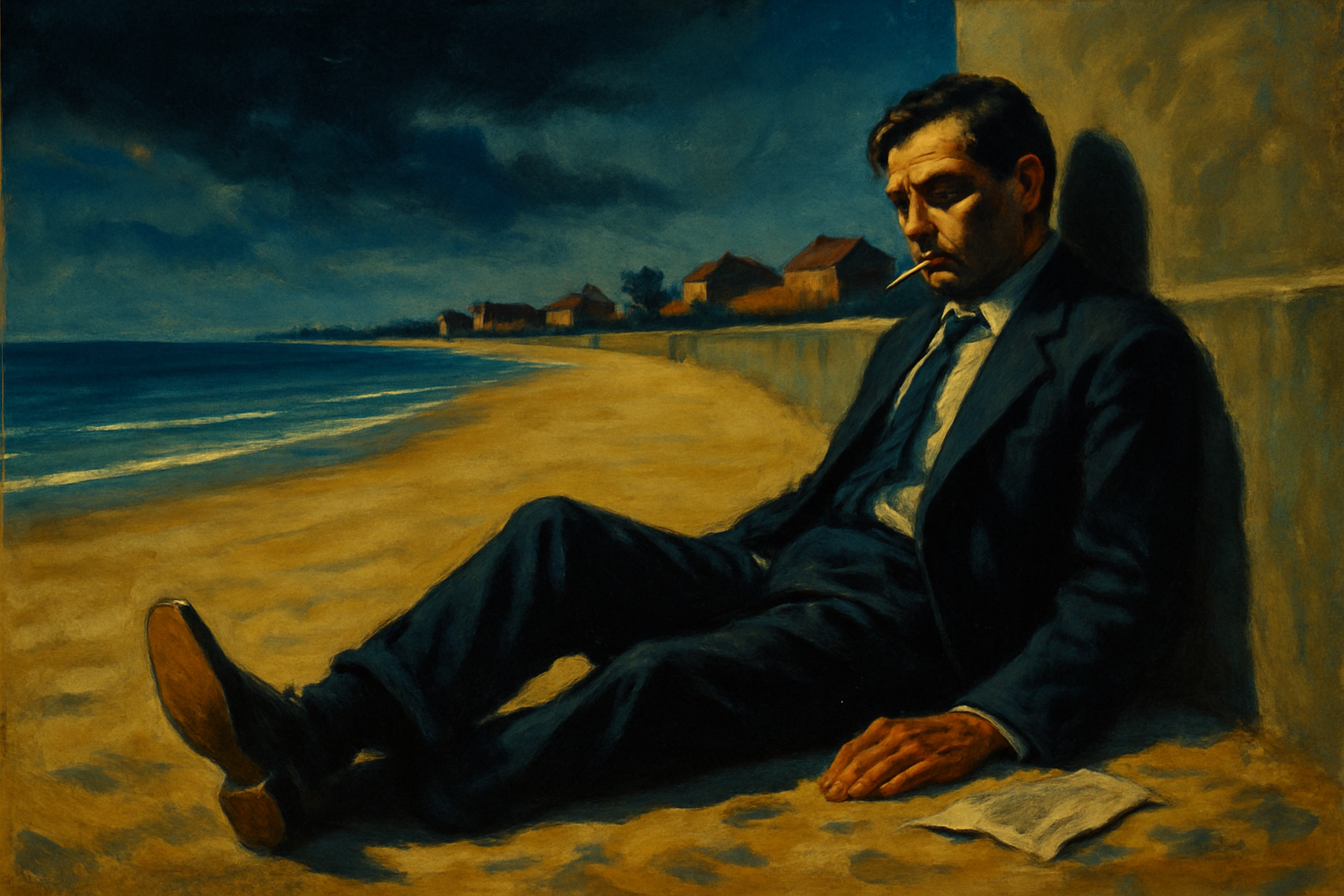
They found him leaning against the seawall at Somerton Beach, an unlit cigarette resting on his collar as though it had fallen from his lips.
It was the morning of December 1, 1948, on the sand near Glenelg, a suburb of Adelaide, South Australia. A well-dressed man in a suit and polished shoes sat propped against the seawall, dead. There was no wallet, no identification, no name sewn into his clothing — the labels had been cut out. In a hidden fob pocket in his trousers, investigators later found a tiny, tightly rolled scrap of paper bearing two printed words in an ornate typeface: Tamám Shud — a Persian phrase meaning "it is ended," the final words of the poem collection known as the Rubáiyát of Omar Khayyám. The man carried no story, no past, and no future anyone could trace. Nearly eighty years later, the case remains one of the strangest unidentified-death mysteries on record.
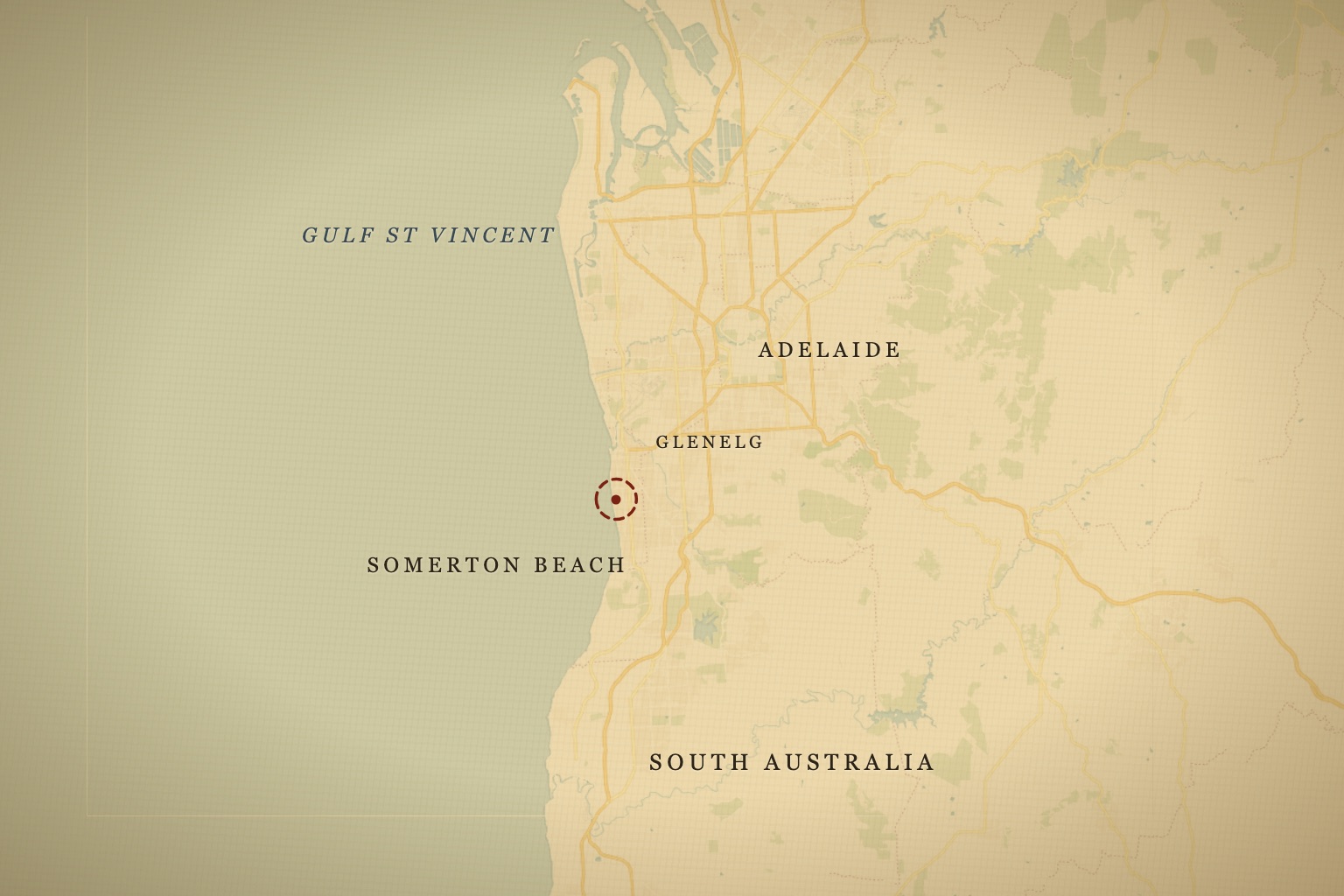
The Location
Glenelg is one of Adelaide's oldest and most popular seaside suburbs, a stretch of pale sand along Gulf St Vincent about ten kilometres southwest of the city centre. In 1948 it was a resort town of guesthouses, a jetty, and a tram line running straight in from the city — the kind of place people came to swim and stroll on a summer evening. Somerton Beach sits just south of the main Glenelg foreshore, quieter, backed by a low seawall and a scattering of houses.
The setting matters, because the man did not die in some remote wilderness. He died in plain sight, in a populated resort suburb, and several witnesses reported seeing him there the evening before — one couple said they noticed a man in the same spot the previous night, apparently moving an arm, and assumed he was drunk or asleep. He was found the next morning against the same wall by people out on the beach, and passers-by initially assumed the seated figure was simply resting or intoxicated. He was slumped with his legs extended and crossed at the ankles, and the unlit cigarette on his collar became one of the enduring details of the crime-scene descriptions.
A body in a business suit, in December's Australian summer heat, on a public beach, with no name and no obvious cause of death — the ordinariness of the place is exactly what makes the case so unsettling. The man appeared healthy and well cared for. He was clean-shaven, in his forties, physically fit, and dressed with a deliberate neatness that seemed at odds with a lonely death on the sand. Whatever had happened to him had happened quietly, within sight of houses and a foreshore where ordinary evening life carried on around him.
The Hunt
The Somerton Man case has drawn generations of investigators precisely because it sits at the intersection of forensic detective work and pure cipher-cracking — a genuine puzzle with physical evidence still in hand.
The search for his identity began immediately, but nothing about the body offered an easy answer. His pockets held a strange, curated set of everyday items and nothing personal at all: a used bus ticket, an unused rail ticket, a comb, a packet of chewing gum, matches, and cigarettes. The absence of a wallet, keys, or any document with a name was itself suggestive — either the man had deliberately stripped himself of identity, or someone else had done it for him. The removal of the clothing labels only deepened that impression. Ordinary people do not usually cut the tags out of their own suits.
The first real break came weeks after the body was found. In January 1949, staff at the Adelaide railway station discovered an unclaimed brown suitcase that had been checked into the cloakroom on November 30, 1948 — the day before the man was found. Inside were clothes with the name tags removed, along with an odd assortment of items: a stencilling brush, scissors, and thread. Some items bore traces of a name — variations of "T. Keane" — but investigators could never link any Keane to a missing person, and concluded the tags may have belonged to someone else entirely. The stencilling equipment led to speculation that the man had worked in some trade that involved marking cargo or equipment, but it never produced a firm lead. The suitcase, like the body, seemed designed to say nothing.
The most famous lead came from the rolled "Tamám Shud" scrap itself. Police appealed to the public, and a man came forward with a copy of the Rubáiyát that he said had been tossed into the back seat of his unlocked car parked near Glenelg around the time of the death. A torn section was missing from the final page — and the "Tamám Shud" fragment found on the body matched the tear. The match was physical and specific: the fibres and the shape of the torn edge lined up, tying the tiny scroll of paper in the dead man's fob pocket directly to that particular book. It was the closest the investigation ever came to a thread leading somewhere.
Inside the back cover of that same book, faintly pencilled, were two things that turned a strange death into a decades-long obsession: a local telephone number, and a sequence of capital letters arranged in lines that resembled a code. The lettering was faint and had to be brought out under ultraviolet light before it could be read at all. It has since been photographed, enhanced, and pored over by cryptographers, hobbyists, and intelligence agencies for more than seventy years. No one has ever produced an accepted solution.
The case has stayed on camera, too. Discovery's Expedition Files put Josh Gates on it in the Season 3 episode "Time Reveals All" (November 2025) — a treatment built around the one thing seventy years of earlier coverage never had: a name to test the legend against. The episode walks the beach, the code, and the DNA work in that order, which happens to be the order the evidence actually arrived in.
What History Says
The physical evidence has always pointed in two directions at once — ordinary and impossible.
The 1949 inquest, led by coroner Thomas Cleland, could not establish the man's identity or a cause of death. The pathologist, John Matthew Dwyer, found the man's organs congested and his spleen abnormally enlarged, and suspected poisoning — possibly a barbiturate or a glycoside — but no poison was detected in the toxicology available at the time. The state of the internal organs suggested to Dwyer that something had killed the man that the available chemistry could not confirm, and the possibility of a poison that broke down quickly or left no detectable residue hung over the proceedings. Cleland recorded that he was unable to say who the man was, how he died, or whether the death was natural. The verdict was, in effect, a documented blank — a rare formal admission that the medical and investigative apparatus of the day had come up empty on every front at once.
The code has been the case's magnet ever since. The pencilled letters — commonly transcribed with lines beginning roughly WRGOABABD, and so on, with an apparent crossed-out line — have resisted every standard cryptographic attack. There are only a handful of lines, and the text is far too short for the statistical methods that break most ciphers to gain any traction. Analysts have argued they may not be a cipher at all but the initial letters of words, perhaps a mnemonic or a personal shorthand, which would make them nearly impossible to solve without knowing the underlying text. If each letter stands for the first letter of a word in some sentence known only to the writer, no amount of cryptographic firepower can recover it. The Australian Navy and later academic teams, including code specialists at the University of Adelaide led by Professor Derek Abbott, have studied the letters for years without a definitive result. Every so often a new proposed solution circulates, but none has ever won broad acceptance among people who have examined the original.
The telephone number in the book led to a young nurse living near Somerton Beach, later publicly identified as Jessica "Jo" Thomson. She had owned a copy of the Rubáiyát and had reportedly given one to a soldier during the war. When shown a plaster cast of the dead man's face, witnesses said she appeared deeply shaken — but she denied recognising him and never publicly identified him before her death in 2007. Her possible connection became the emotional heart of the case, and much of the enduring public fascination has grown up around the question of what, if anything, she knew. Those who pressed the theory noted that her home was only a short walk from where the body was found, and that her reaction to the plaster cast seemed to say more than her words did. But she never spoke openly about it, and the truth of that moment went with her.
The Verdict
For most of its history the Somerton Man case had no ending at all — no name, no cause, no motive, and a code that stared back blank. The very completeness of the mystery — a man erased down to the labels in his clothes — was what kept it alive in books, documentaries, and amateur investigations for decade after decade. What finally changed came from the lab, not the beach. In 2021, South Australian authorities exhumed the body, and researchers led by Professor Derek Abbott, working with genetic genealogist Colleen Fitzpatrick, reported in 2022 that they had used DNA extracted from the remains and public genealogy databases to identify the man as Carl "Charles" Webb, an electrical engineer and instrument maker born in Melbourne in 1905. The identification relied on the same forensic-genealogy approach that had cracked other long-cold cases in recent years — building family trees outward from distant DNA matches until they converged on a single name. As of that reporting, the identification had not been formally confirmed by the South Australian government's own testing.
Even if the name holds, the mystery is far from closed. Knowing the man was born in Melbourne in 1905 and worked with instruments tells us who died on that beach, but not why he was there, more than a thousand kilometres from home, carrying nothing that could identify him. No one has explained how or why Webb died on that beach, why his labels were cut away, what the pencilled letters mean, or whether the "Tamám Shud" scrap was a message, a farewell, or a coincidence. The connection to Jessica Thomson, the origin of the stencilled suitcase, and the true nature of the code all remain open. The seawall at Somerton Beach is still there, walkable at sunset. The book, the suitcase, and that page of letters survive in the record — a puzzle that finally gave up a name, and almost nothing else.
Explore the sites mentioned in this post on the interactive map.
Open the Tracker