Oak Island: 200 Years of Digging and Still No Answer
The Mystery
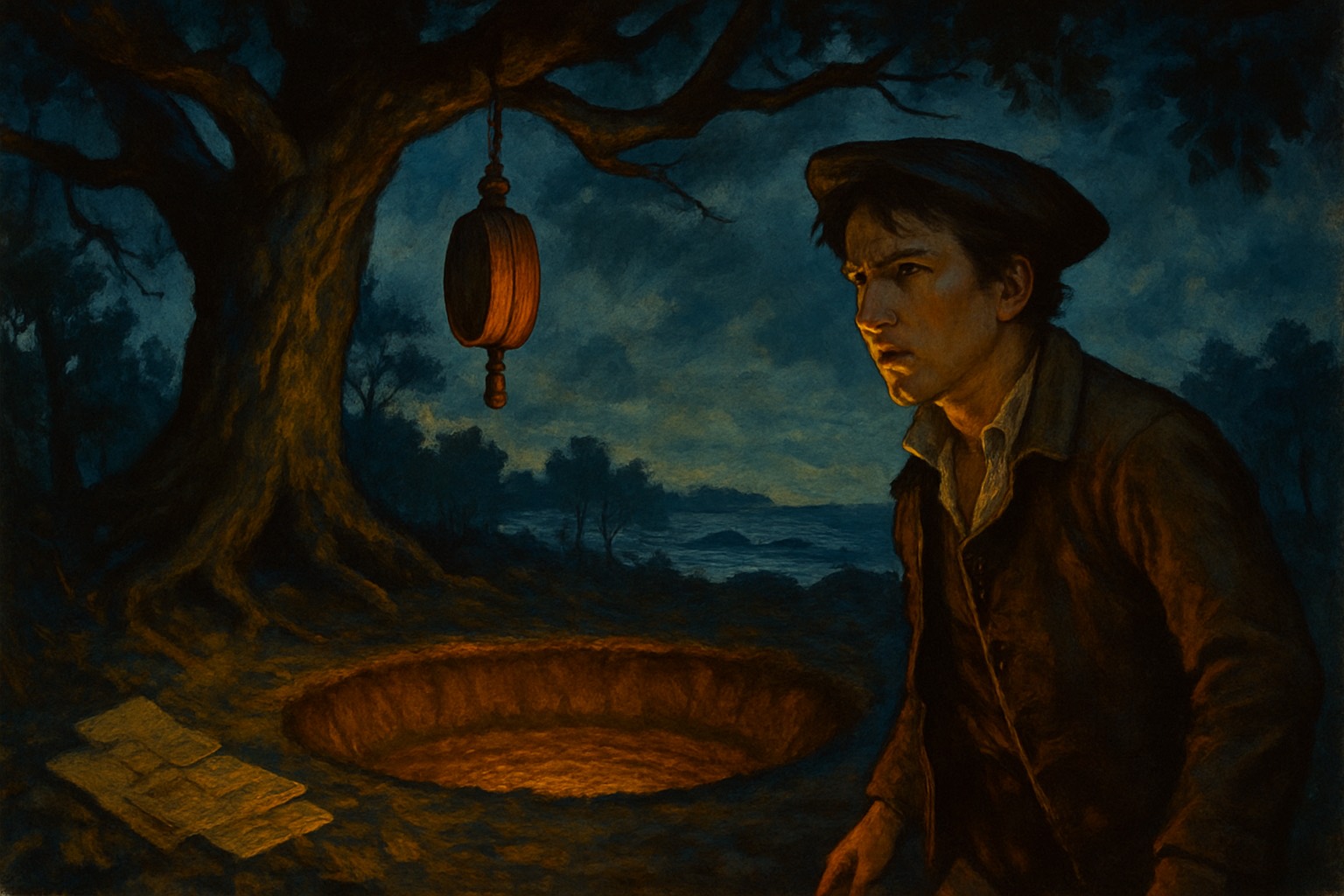
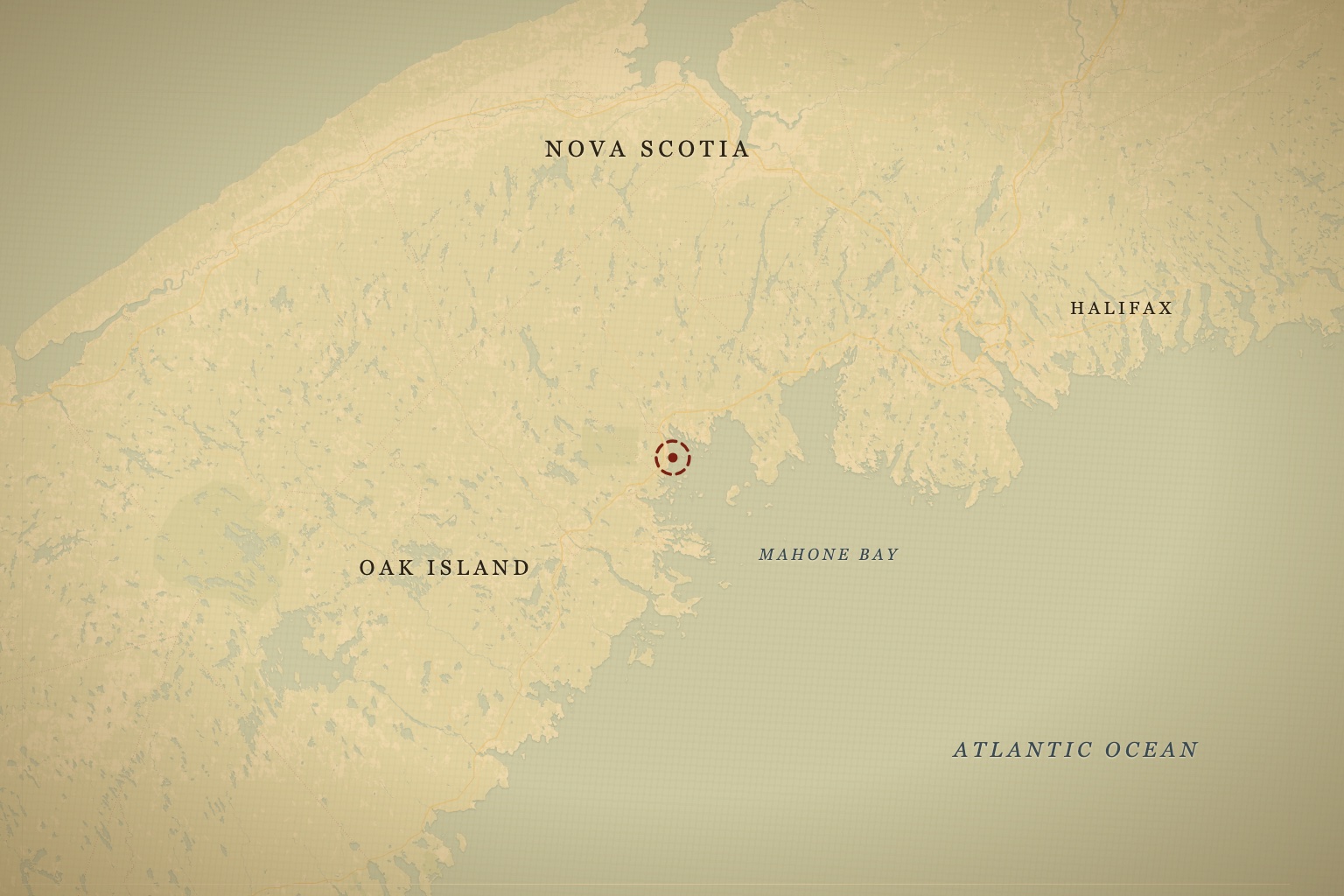
In 1795, a sixteen-year-old named Daniel McGinnis rowed out to Oak Island — a 140-acre island off the coast of Nova Scotia, accessible by a short causeway in the wooded reaches of Mahone Bay — and found a circular depression in the earth beneath an old oak tree. The depression was perhaps twelve feet across, the kind of soft, settled hollow that forms over ground that has been dug and refilled. The tree's branches, by the account that has come down to us, showed signs of rope use — a worn limb directly above the depression, as though something had once been lowered into the earth. McGinnis, sensing buried treasure, came back with two friends and started digging.
It helps to understand the world McGinnis was imagining into. The late eighteenth century was barely a lifetime removed from the great age of Atlantic piracy, and the Nova Scotia coast — all coves, blind inlets, and uninhabited islands — was exactly the kind of place where popular legend insisted buccaneers had stashed their plunder. To a teenager standing over a man-made hollow under a marked tree, the conclusion was not fanciful. It was the obvious one.
Ten feet down: a platform of oak logs, set into notches cut in the shaft walls. Twenty feet: another. Thirty feet: another. The platforms kept coming. This was the detail that turned a boy's afternoon into a two-century compulsion — because a natural sinkhole does not lay down a tidy floor of timber every ten feet. Someone had gone to considerable effort to build something deep in this ground, and whatever it was, it was still there, waiting beneath layers of deliberate construction.
That shaft — eventually christened the Money Pit — became one of the most expensive and deadly holes in history. The three boys dug as far as their arms and nerve allowed and then, defeated by the depth, went home. But the story did not die with their effort; it festered and spread, and by the early 1800s a more organized operation, the Onslow Company, had taken up the dig. They reported finding a flagstone bearing strange markings and, at roughly ninety feet, a stone inscribed with a cipher — symbols later "translated," with characteristic convenience, to read forty feet below two million pounds are buried. No one alive has examined that stone; it vanished from the record more than a century ago, and its very existence rests on secondhand testimony. Below it, the shaft flooded — fast, and to the brim with seawater.
The flooding is the heart of the legend. Subsequent investigation pointed to an elaborate drainage system: tunnels said to connect the pit to the ocean at nearby Smith's Cove, engineered to flood the shaft if anyone dug too deep. Diggers reported finding layers of coconut fiber and beach stone — material foreign to the island — arranged as if to form a filter. The implication was staggering. Whoever built this had not merely buried something; they had armed the ground around it.
The engineering implied intent. Someone, the story goes, went to serious lengths to protect whatever was buried here, and they were sophisticated enough to design a hydraulic booby trap that still works two hundred years later. And so the theories multiplied. The treasure has been attributed to Captain Kidd, Sir Francis Drake, fleeing Spanish sailors, French colonists hiding the payroll of the fortress at Louisbourg, the Knights Templar, the Freemasons, and at least one researcher who believes the pit holds Francis Bacon's proof that he wrote the works of Shakespeare, sealed in mercury to preserve the manuscripts. Others have proposed Marie Antoinette's jewels, smuggled out of revolutionary France; the Holy Grail; even the Ark of the Covenant. Six people have died in the excavation attempts. Six separate syndicates have spent and lost fortunes. And in one strand of the story, a young Franklin Delano Roosevelt dug here in 1909 with a treasure company of his own, and reportedly followed news of the search for the rest of his life, writing letters about it from the White House.
The Money Pit has consumed everyone it has touched. The only question that has ever mattered is whether there is anything down there to find.
What the Laginas' Dig Has Found
The modern dig runs on camera. Rick and Marty Lagina — the Michigan brothers who hold the current treasure license — have made their excavation the subject of History's long-running series The Curse of Oak Island, on the air since January 2014 and heading into a fourteenth and final season in late 2026. A television production has every incentive to want the legend to be true, and that is worth keeping in mind when weighing what follows. It does not change what the cameras have documented coming out of the ground.
The artifacts the Laginas' team has recovered from the site and the surrounding ground make an inventory that is genuinely difficult to wave away. A small lead cross, its design likened to early Iberian or Templar iconography, recovered with a metal detector from a field on the island. A Spanish copper coin from the colonial era, the kind of currency that circulated through Atlantic ports centuries before McGinnis was born. And — most arresting — fragments of human bone recovered from a borehole deep in the Money Pit area, which DNA analysis attributed to two different people, one of European ancestry and one Middle Eastern, and which carbon dating placed between 1682 and 1764 — decades before the Money Pit legend supposedly began.
Then there is the swamp. A roughly triangular marsh sits in the island's interior, and the Laginas have long suspected it is not entirely natural. Survey work and excavation in and around the swamp turned up worked wood and stone arrangements that some on the team interpreted as the remnants of an old wharf or slipway — a built structure, submerged in muck, hinting that the island was once a place where boats were loaded and unloaded rather than merely a place where something was hidden. The features are old enough, and odd enough, to complicate any simple treasure-burial narrative.
It is worth stating plainly what the evidence does and does not establish. What it suggests: there is something anomalous about Oak Island, and the material record points to human activity predating the 1795 discovery by a considerable margin. What it does not prove: that the activity has anything to do with treasure, that the artifacts share a single origin, or that an original cache ever existed. A coin and a cross can arrive on an island a dozen mundane ways — dropped by a fisherman, salted by a hoaxer, carried in fill dirt — and a single carbon date tells you the age of a bone, not the story of how it got into the ground.
That uncertainty is structural, not incidental. Two centuries of excavation have so thoroughly churned the site that establishing the provenance of any single artifact — let alone proving a cache exists — may now be impossible. The treasure hunters have almost certainly collapsed the very tunnels they were trying to reach. The flooding systems they fought to defeat have, in the process of being defeated, been destroyed. The record is contaminated at a depth and scale that no amount of modern technology fully overcomes. Every honest investigator has had to leave Oak Island in the same place: convinced something is there, unable to say what.
Historical Context
The Oak Island story is almost always framed as a treasure mystery, but the more unsettling — and more interesting — possibility is that it was never about treasure at all.
The bone fragments, dated to between 1682 and 1764, put human remains deep underground on Oak Island a generation or more before Daniel McGinnis ever rowed out — and the DNA result is stranger than the date: two different individuals, one of European ancestry and one Middle Eastern, more than a hundred feet down. That should not be quietly folded into the pirate story; it complicates every version of it. Who was buried that deep in Mahone Bay before the legend even began? The worked-wood structures in the swamp, if they are structures, suggest Oak Island may have been a working site — a landing, a fishing station, a place put to ordinary use by people whose names we do not have — rather than a vault. The island sits on a coast with deep human history: the Indigenous Mi'kmaq have inhabited it for thousands of years, Norse activity in Atlantic Canada is firmly documented at L'Anse aux Meadows in Newfoundland around the year 1000, and some researchers have argued, more speculatively, for early Iberian, Basque, or Portuguese fishing and whaling traffic along the Nova Scotia coast in the years before the formal colonial period. None of that requires buried gold. All of it would leave debris.
The lead cross resists tidy categorization. Cross-shaped religious objects were common across medieval and early-modern Europe and turn up throughout the Americas after contact, so the form alone proves little; what would matter is a secure date and a documented findspot, and Oak Island, after two centuries of looting and digging, can offer neither with confidence. An artifact recovered by metal detector from disturbed ground is an interesting object and a useless witness.
On the other side of the ledger sits the most deflating theory of all, and it deserves a fair hearing: that the famous flood trap is not a trap. Geologists have noted that Atlantic coastal islands can contain natural networks of porous beach material — what are sometimes called cobble drains — capable of channeling seawater inland and flooding any deep shaft sunk into them. Sinkholes and natural cavities form readily in the soluble bedrock of the region. If the flooding is geology rather than engineering, the entire premise inverts. The log platforms may still be real. An inscription stone may once have existed. But the menace those features seemed to imply — the idea that the island was defended — collapses into ordinary hydrology, and the original diggers become men who mistook a wet hole for a fortified one.
This is why modern archaeology counsels restraint on Oak Island. The site has too many layers of disturbance — literally, vertically, in the ground itself — to yield clean conclusions. Every shovel that went looking for an answer destroyed a little of the evidence that might have provided one.
Why It Matters
Oak Island is the longest-running treasure hunt in the world, and its sheer durability says something about how human beings relate to the unknown. The psychological engine of the Money Pit is that the prize is always one layer farther down: one more platform of logs, one more flooded shaft, one more half-legible stone. The site — whether its design is human or natural — produces almost exactly the experience most likely to keep people digging. It rewards effort with the appearance of progress and withholds the only thing that would end the search, which is an answer. That is not a description of a treasure vault. It is a description of an addiction.
There is a harder truth folded into this one. The search may have destroyed the very thing it was chasing. If a cache exists, the warren of excavation tunnels has almost certainly crushed it or scrambled its context past recovery. If the real story is a pre-contact Indigenous site or an early European landing, then a century of dynamite, drilling, and steel caissons has shattered a genuine archaeological record into fragments no one can reassemble. The most valuable thing Oak Island may ever have contained could be a piece of ordinary history — and the hunt for an extraordinary one may have ground it to powder.
That is the real lesson buried in the Money Pit, and it is worth more than gold. Some mysteries are fragile. They survive only as long as we resist them. The harder we dig, the deeper, the more impatiently — the less there is left to find, and the less we will ever be able to know. Oak Island is a case study in what obsession costs: not only six lives and six fortunes, but legibility itself. After two hundred years, the most honest thing anyone can say about the island is that we have spent two centuries making sure we will never be certain.
Visit the Region
Oak Island itself is private property. The Lagina brothers hold the land and the active treasure license, and general public access to the excavation sites is not permitted — so set expectations accordingly. But the surrounding region rewards the trip for anyone pulled in by the story, and it can be built into a satisfying two- or three-day loop along Nova Scotia's South Shore.
The Oak Island Interpretive Centre, Western Shore. Operated in association with the Friends of Oak Island Society, this visitor centre near the foot of the causeway is the closest the public can legally get to the legend. It houses exhibits on the island's history and the centuries of excavation, including artifacts and reproductions tied to the dig, and it is the staging point for any officially sanctioned tours that may be running during your visit. It sits just off Route 3 in Western Shore; hours are seasonal — generally late spring through fall — so confirm current opening times before you drive out. Even when the centre is closed, the view of the island from the public vantage along Route 3 is free to anyone.
The Maritime Museum of the Atlantic, Halifax. About an hour east, on the Halifax waterfront at 1675 Lower Water Street, this is the anchor museum for understanding the seafaring world that produced the Oak Island legend. Its collections span colonial-era shipping, shipwreck recovery, the age of sail, and Nova Scotia's deep maritime past — exactly the context for the period when the Money Pit was first sunk and first searched. Plan on a couple of hours; check the museum's current hours and admission, which vary by season.
Lunenburg Old Town, UNESCO World Heritage Site. Roughly twenty minutes south of Western Shore, the Old Town of Lunenburg is the best-preserved planned British colonial settlement in North America and a World Heritage Site in its own right — a grid of brightly painted eighteenth- and nineteenth-century buildings stepping down to a working waterfront. It is also home port to the schooner Bluenose II. Give it a full afternoon, at minimum; it earns a separate day.
Mahone Bay and Chester. Between Lunenburg and Western Shore, the village of Mahone Bay is known for the row of three churches mirrored in the harbor — one of the most photographed scenes in the province — and a walkable main street of shops and cafés. A little farther up the coast, the sailing village of Chester offers quiet harbor views and a gateway to the bay's scattering of islands, of which Oak is only one. Together they make the short drives between the bigger stops worth slowing down for.
Explore the sites mentioned in this post on the interactive map.
Open the Tracker