The Lost Colony of Roanoke: The Word Carved Into a Post
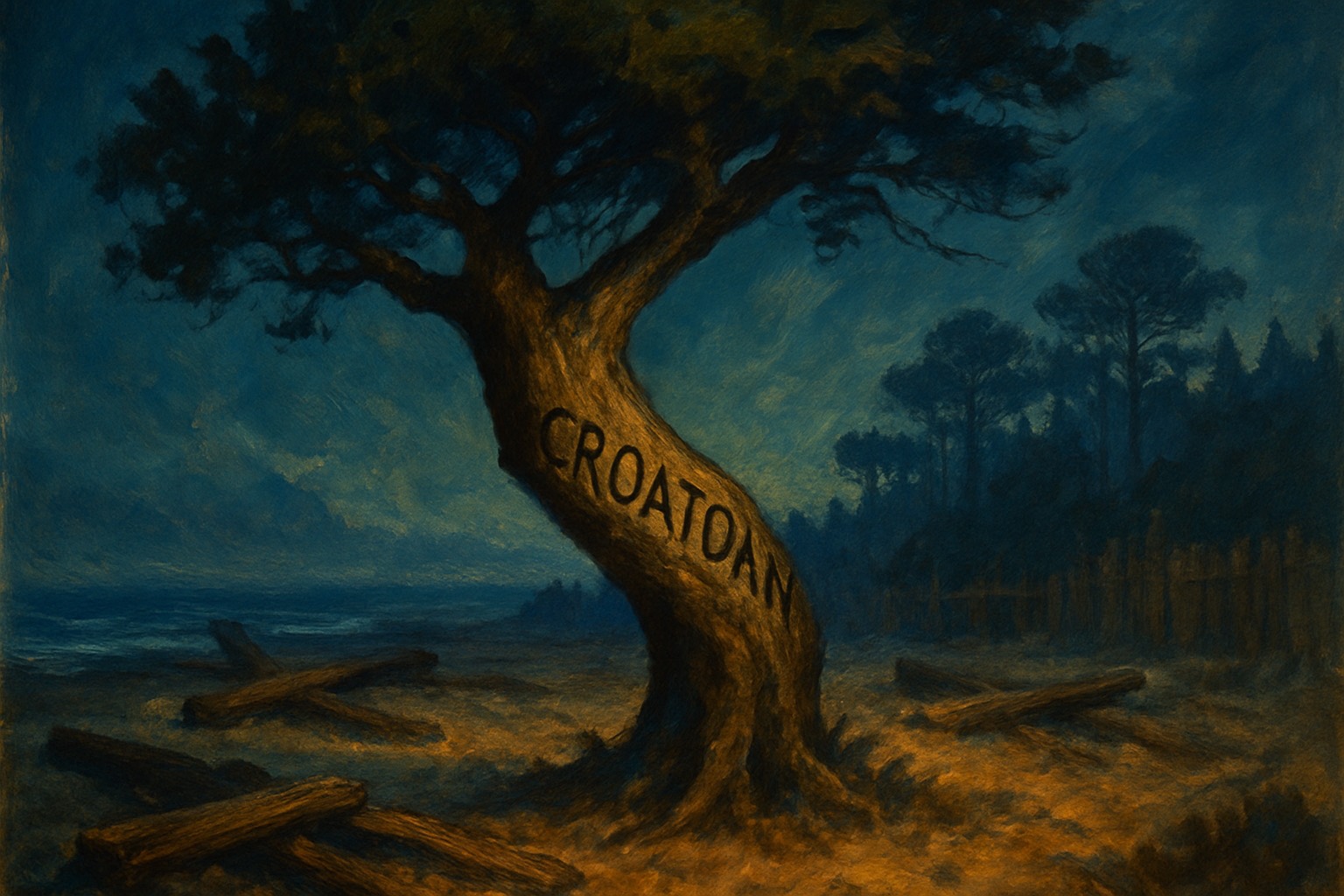
When John White finally made it back, the only thing waiting for him was a word.
In August 1590, after three years of war-delayed crossings and the loss of the men he had sent ahead, the colony's own governor stepped back onto Roanoke Island off the coast of present-day North Carolina. He had left behind 115 people — including his daughter, Eleanor, and his granddaughter, Virginia Dare, the first English child born in the Americas. He found the houses gone, the settlement taken apart, and no sign of the colonists, living or dead. There were no bodies. There were no graves. Carved into one of the palisade posts was a single word: CROATOAN. On a nearby tree, the letters CRO. White had given his colonists an instruction before he left — if they moved, carve their destination, and add a Maltese cross if they left under distress. There was no cross. Just the word.
The Mystery
Roanoke was England's first serious attempt at a permanent New World colony, and it failed twice before it vanished. The expeditions were promoted by Sir Walter Raleigh, who held a royal charter from Queen Elizabeth I to settle land he named Virginia in her honor. A 1585 attempt left a garrison of men on Roanoke who, short on supplies and in conflict with the surrounding Algonquian-speaking communities, abandoned the island and caught a ride home with Sir Francis Drake the following year.
The 1587 attempt was different — it was meant to be a real colony, with families. John White, an artist who had documented the region's people and wildlife on earlier voyages, was named governor. The group of roughly 115 colonists intended to settle farther north on the Chesapeake Bay, but their pilot deposited them at Roanoke instead and refused to take them onward. They were stranded at a site they hadn't chosen, late in the season, in a place where the previous English presence had already soured relations with the local nations.
Within weeks, the colony was running low on supplies. White was persuaded to sail back to England for more — leaving behind his family and his colonists with an agreement about how they would signal him if they had to move. He could not have known how long he would be gone.
What stopped him was the largest naval conflict of the age. England was bracing for the Spanish Armada, and Queen Elizabeth ordered nearly every seaworthy vessel held for national defense. White's attempts to return were blocked, then diverted; one relief voyage he managed to launch in 1588 used two small vessels deemed too minor for the war effort, but their crews turned to privateering, were attacked, and limped back to England without ever reaching America. By the time he secured passage and set foot on Roanoke again in August 1590, three years had passed. The colonists were gone, and the word CROATOAN was the only message they left.
It is worth sitting with the detail of that homecoming, because it is the hinge of the entire mystery. White's own account describes finding the settlement enclosed by a defensive palisade that had not been there when he left — meaning the colonists had time to build, not flee. The houses had been dismantled rather than burned. Some of the heavy goods White had left in the colonists' care had been dug up and scattered, including his own books and armor, suggesting departure and later disturbance rather than a sudden attack. And there was the absence that defines the case: no struggle he could read in the ground, no remains, no graves. To a governor returning to find his family gone, the dismantled, orderly, body-less site read less like a crime scene and more like a forwarding address.
What Josh Gates Found
In Expedition Unknown (Season 3, Episode 4, "The Lost Colony of Roanoke," which aired in November 2016), Josh Gates took on what he framed as America's first missing-persons case. The episode's premise was straightforward and, for once, anchored in a genuine documentary lead rather than legend: investigators had surfaced newly examined clues, and the question was whether modern archaeology could finally say where 115 people went.
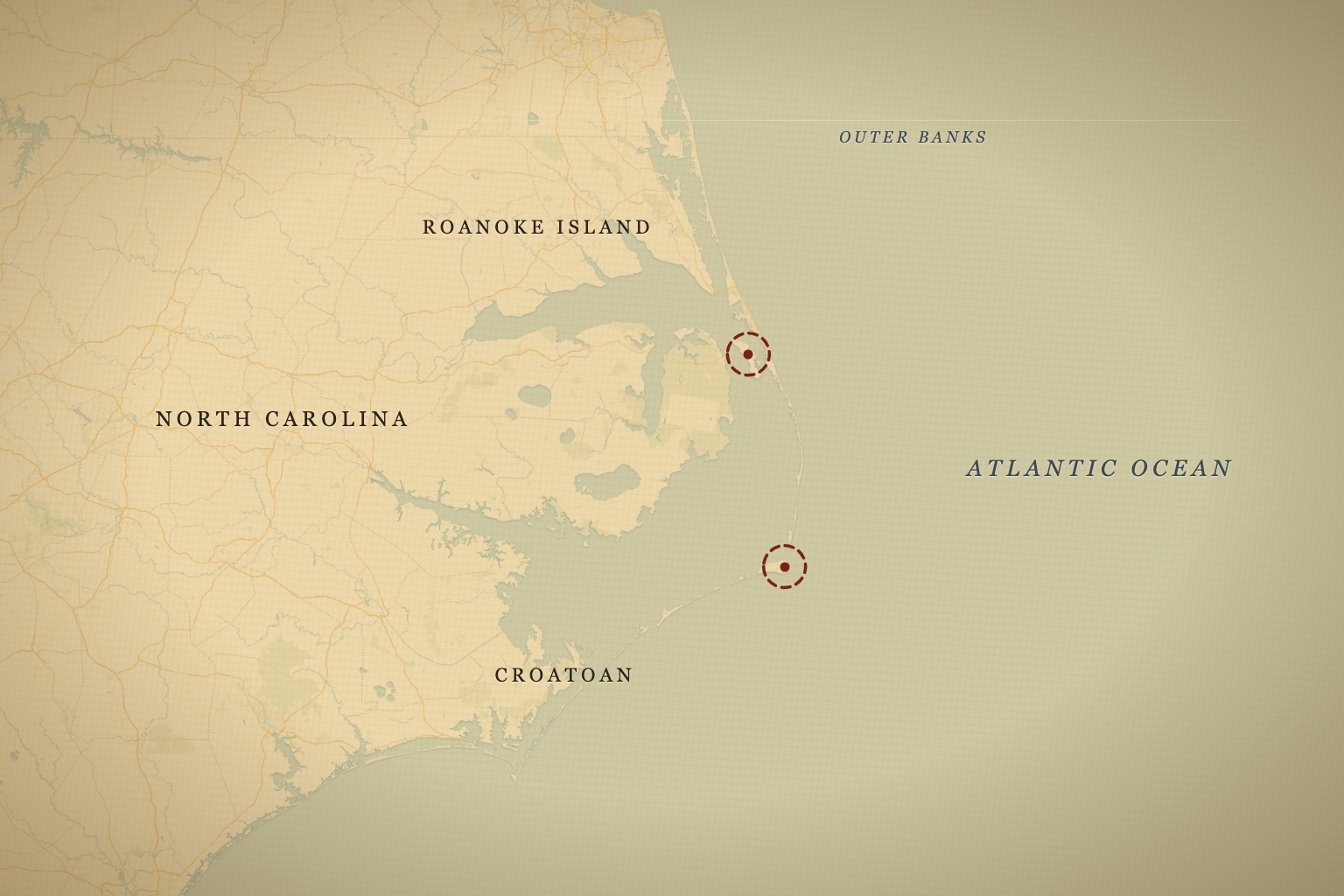
Gates worked the geography the way a cold-case detective works a neighborhood. CROATOAN was not a riddle to the colonists — it was a place name. Croatoan was the contemporary name for present-day Hatteras Island, roughly 50 miles south of Roanoke, and the home territory of the Croatoan people, with whom the English had their most cooperative relationship. One of those people, Manteo, had even traveled to England and back. The carved word, read plainly, points south to a known, named, friendly place. That reading has been on the table since White himself stood in front of the post and concluded his people had relocated to Croatoan.
The frustration of the case — and Gates leaned into this honestly — is that White never got to follow the clue. A storm came up as he tried to sail to Croatoan, his ships were damaged and short of supplies, and his crew refused to continue. He was forced back to England and, by all accounts, never returned to the New World or saw his family again. The most obvious lead in the entire mystery went uninvestigated for centuries. What Gates pursued on screen was the archaeology that has tried, recently, to do what the storm prevented: test whether the colonists actually went where the post said they went, and whether any trace of them survived.
Gates has since returned to the case. In his newer Discovery series Expedition Files — specifically Season 1, Episode 4, "Lost Civilizations," which aired in 2024 — he revisits Roanoke with the Hatteras Island archaeology that has moved forward since the 2016 episode. On Croatoan ground, he joins the dig as it pulls European objects out of Native contexts: a glass trade bead and, most pointedly, the handle of a rapier. The sword is the detail that does the work. A colonist would not have bartered away a weapon, so a rapier sitting in a Croatoan site is hard to explain as ordinary trade — it reads as something an English person carried there and left. It is the same throughline the older episode chased, now with more dirt turned: the physical case that the people of Roanoke went south to the place named on the post, and stayed.
What History Says
The honest state of the evidence is that there is no proof of a single dramatic event — no massacre layer, no mass grave, no burned settlement with bodies. What there is, instead, is a slow accumulation of archaeological hints pointing toward assimilation rather than annihilation.
Two leads have driven serious fieldwork. The first follows the carved word south to Hatteras Island. The Croatoan Archaeological Society and archaeologist Mark Horton of the University of Bristol have excavated sites there and recovered European-style objects in Native contexts — including a slate writing tablet, fragments of swords or weaponry, and other items consistent with the late 16th century. The interpretation is contested: trade and salvage could account for some artifacts. But the layering of certain finds has been read as evidence of English colonists living among the Croatoan, blending into the community rather than dying out.
The second lead emerged from an unlikely source: White's own watercolor map of the region, known as "La Virginea Pars," held by the British Museum. In 2012, researchers examining the map found that two small patches had been glued over part of it. Viewed on a light table and under imaging, the patches concealed a hidden symbol — a four-pointed star resembling a fort — marked at a site inland, near where the Chowan and Roanoke rivers meet. Why White hid the marking is unknown; one possibility is that it indicated a planned fallback location the colonists meant to keep secret from Spanish rivals. The discovery launched excavations at what archaeologists call "Site X" near Bertie County, North Carolina, where the First Colony Foundation recovered fragments of English ceramics, including Border ware pottery, consistent with the late 16th century. The theory: some colonists may have split off and moved inland to live near or among Native communities there, exactly where the governor's own map quietly pointed.
Neither site has produced a definitive "the colonists were here" artifact — a personal item, a documented name, a grave. What the work has done is shift the consensus among researchers away from the idea of a single catastrophe and toward the likelihood that the colony fragmented, and that survivors were absorbed into the Indigenous societies of the region. That is not a tidy ending, but it fits the one piece of hard evidence everyone agrees on: there were no bodies on Roanoke.
The Verdict
What can be said with confidence is small and stubborn. The colony existed. The people were real. They left a deliberate, legible message naming a real, friendly, nearby place. And no one in 1590 — or since — has produced their remains. Everything past that is inference.
The most evidence-supported reading is the least cinematic: the colonists did not vanish so much as disperse and assimilate, some perhaps toward Croatoan and the Hatteras community, some perhaps inland. The dramatic alternatives — a Spanish attack, a hostile wipeout, starvation with no survivors — have no archaeological footprint to support them.
You can stand where this happened. Fort Raleigh National Historic Site on Roanoke Island, operated by the National Park Service, preserves the area of the settlement, and ongoing excavations on Hatteras Island and at the inland sites continue each season. The file on America's first missing-persons case is not closed. But for the first time in four centuries, the dig is finally following the word on the post — south, toward the people who carved it.
The Roanoke mystery is featured in both Expedition Unknown (Season 3) and Expedition Files (Season 1) with Josh Gates, an explorer and television host who has spent decades investigating historical mysteries and archaeological sites across the globe.
Covered On Screen
- The Lost Colony of RoanokeExpedition Unknown · S3 E4
Explore the sites mentioned in this post on the interactive map.
Open the Tracker