The Lost City of Z: Percy Fawcett's Final Expedition
The Mystery
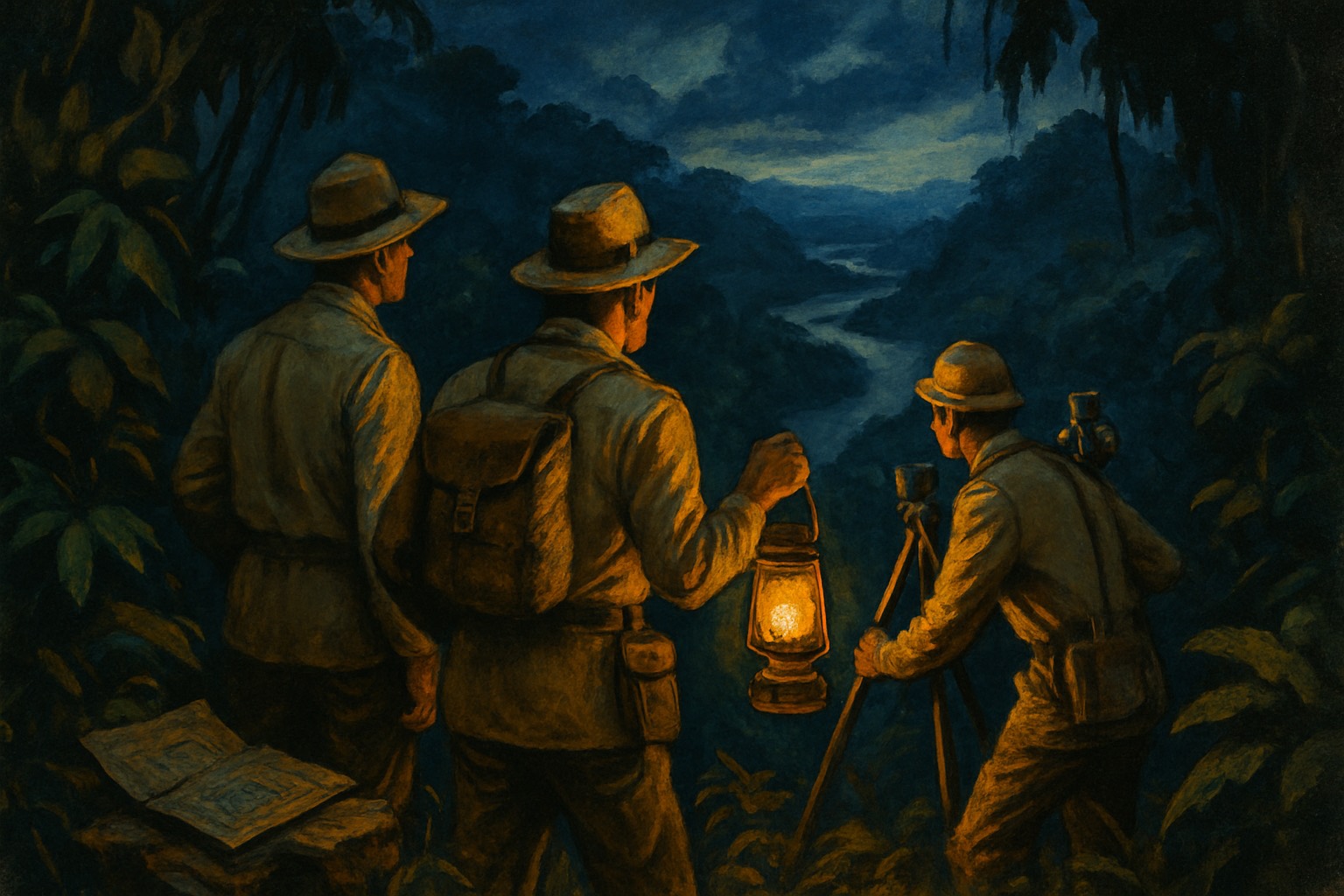
In 1925, Lieutenant Colonel Percy Harrison Fawcett disappeared into the Brazilian Amazon along with his eldest son Jack and Jack's friend Raleigh Rimmell. They were searching for what Fawcett called "Z" — an ancient lost city he believed existed deep in the Mato Grosso region.
Fawcett was no amateur. He was a Fellow of the Royal Geographical Society with years of surveying experience in South America. His previous expeditions had mapped uncharted territory and encountered indigenous groups never before contacted by outsiders. Born in Torquay, England, in 1867, he was commissioned into the Royal Artillery at nineteen, served in Ceylon, and trained in surveying under the Royal Geographical Society before the RGS sent him to South America in 1906 to help resolve a boundary dispute between Bolivia and Brazil — contested rubber country where an inaccurate map could start a shooting war. Between 1906 and 1924 he ran seven expeditions through some of the least-charted terrain on the continent, fixing borders, tracing rivers, and building a reputation for almost inhuman endurance in country that killed or broke most of the men who entered it. He interrupted the work only for the First World War, commanding an artillery brigade on the Western Front in his late forties. In 1916 the RGS awarded him its Founder's Medal for his contributions to the mapping of South America, and it is often said — plausibly, though the debt is hard to pin down precisely — that his dispatches helped inspire Arthur Conan Doyle's The Lost World.
The idea of Z grew out of that fieldwork. Fawcett had seen pottery sherds and earthworks in places the maps marked as empty, and had heard persistent indigenous accounts of old settlements deeper in the forest. He also placed weight on a document in the National Library of Brazil in Rio de Janeiro — the famous Manuscript 512, a 1753 account by Portuguese fortune hunters describing the ruins of a stone city in the interior. How much of his theory rested on that manuscript and how much on his own observations is debated; Fawcett located Z in the Mato Grosso rather than where the 1753 account pointed. But the conviction ran directly against the scientific consensus of his day, which held that the Amazon's poor soils could never have supported anything beyond small, scattered tribes. To the establishment, Z was a fantasy. To Fawcett, it was a survey problem that simply hadn't been solved yet.
In 1925 he set out to solve it. The expedition was funded in part by a newspaper consortium organized through the North American Newspaper Alliance, which bought the rights to his dispatches, and it was deliberately tiny — Fawcett believed a small party could travel light, live off the land, and avoid provoking the groups whose territory it crossed. He took only two companions: Jack, in his early twenties and chosen for his fitness, and Jack's lifelong friend Raleigh Rimmell. Neither young man had real jungle experience. The party left the frontier town of Cuiabá in April 1925 and struck north into the Mato Grosso.
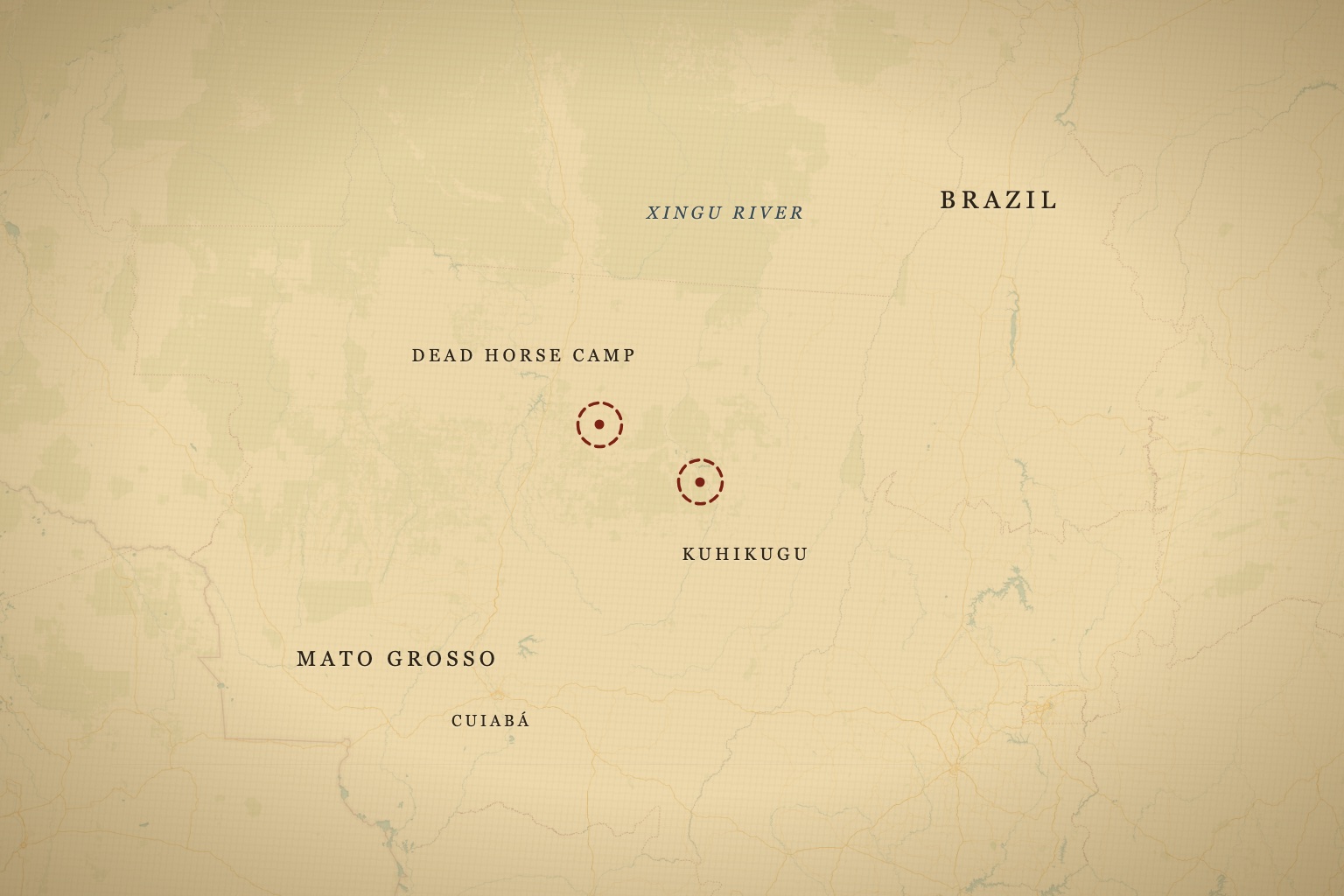
On May 29, 1925, Fawcett sent his last dispatch, carried back by native runners, from a spot he called Dead Horse Camp — the place where his horse had died on an earlier expedition. He reported that the party was about to enter unexplored territory, and closed a letter to his wife Nina with the line: "You need have no fear of any failure." Then, nothing. No further dispatch ever came out of the forest. Decades later, David Grann, reviewing Fawcett's private papers, concluded that even the coordinates in that final dispatch may have been deliberately fudged — Fawcett was obsessively secretive about his route, terrified that rivals would beat him to Z. The last hard data point in the case, in other words, may itself be a false trail.
What the Modern Searches Found
The case has been retraced on screen more than once. PBS's Secrets of the Dead devoted its 2011 episode "Lost in the Amazon" to a modern retracing of Fawcett's final route through the Mato Grosso, working from the physical clues that survive — among them Fawcett's signet ring and a coded map. The deepest modern reporting, though, is David Grann's — the journalist followed the trail himself for his 2009 book The Lost City of Z, later adapted as James Gray's 2017 feature film of the same name, and it was Grann who worked most closely with the indigenous Kalapalo people whose territory Fawcett crossed on his final journey.
The Kalapalo matter here, because theirs is the last credible eyewitness account in the entire case. Their oral history — recorded repeatedly over the decades, including by David Grann during his own reporting — holds that Fawcett's party stayed at a Kalapalo village, was warned against continuing east into the territory of groups the Kalapalo considered dangerous, and went anyway. For several days, the account goes, the smoke of the explorers' campfires could be seen rising to the east. Then it stopped.
The Kalapalo oral history suggests that Fawcett and his companions were killed after traveling east from the Xingu River. But the exact circumstances and location remain disputed nearly a century later. That is the honest state of the evidence, and the modern retracings reflect it: the trail can still show where Fawcett went into the forest and roughly where the record of him ends; it cannot show a body, a grave, or a culprit. No verified remains of any of the three men have ever been recovered. What Grann and the documentary crews who followed could do — something searchers in the 1920s could not — was sit with the Kalapalo as partners rather than suspects, and treat their memory of the event as testimony rather than folklore. In a case where every physical trace has been swallowed by the forest, that oral record is the closest thing to a primary source there is.
Historical Context
What happened after the disappearance is a story in its own right, and a grim one. Fawcett's fame guaranteed that people would go looking, and they did — expedition after expedition, for decades. By one widely cited estimate from Grann's research, as many as a hundred people died or vanished trying to find Fawcett or finish his search.
The first major effort came in 1928, when the North American Newspaper Alliance sponsored a large search expedition under Commander George Miller Dyott. Dyott reached the Xingu region and found suggestive traces — including a metal equipment case traceable to Fawcett's suppliers among the possessions of a local group — and came out convinced the party had been murdered. But the case appeared to date from one of Fawcett's earlier expeditions, and Dyott's conclusion has been questioned ever since. In 1932 a Swiss trapper named Stefan Rattin claimed to have met an elderly white captive he believed was Fawcett; few believed him, and when Rattin went back in to prove it, he too disappeared. In 1951 the Brazilian indigenist Orlando Villas-Bôas announced that the Kalapalo had confessed to the killing and produced bones said to be Fawcett's — but forensic examination in London found they did not match Fawcett's height or dental records, and his family rejected them. Modern Kalapalo, for their part, have maintained that they did not kill Fawcett and that the "confession" was a misunderstanding. As late as 1996 a Brazilian expedition retracing the route was detained by the Kalapalo and released only after surrendering its equipment.
The case found its definitive modern chronicler in David Grann, whose 2005 reporting for The New Yorker — he traveled to the Xingu and recorded the Kalapalo account firsthand — became the 2009 bestseller The Lost City of Z, later a 2017 feature film. Grann's real contribution was not solving the disappearance but connecting Fawcett's obsession to what archaeology was quietly discovering in the very region where he vanished.
Because here is the extraordinary part: Fawcett may not have been entirely wrong. Beginning in the 1990s, the archaeologist Michael Heckenberger of the University of Florida, working in long-term partnership with the Kuikuro people, documented a network of pre-Columbian settlements at the headwaters of the Xingu — the largest known as Kuhikugu. His findings, published in Science in 2003 and expanded in later work, described planned towns arranged around central plazas, linked by broad, straight roads, ringed by defensive ditches, and supported by sophisticated water management — bridges, canals, causeways, and constructed fish ponds. These were not scattered campsites. They were engineered landscapes, occupied by substantial populations for centuries until around European contact, when introduced epidemics likely collapsed the societies that built them and the forest closed over the rest. And in 2018, archaeologists using LIDAR technology revealed that the Amazon once supported complex civilizations with large urban centers connected by road networks — evidence that earth-building peoples settled broad stretches of the southern Amazon, far beyond the Xingu alone.
Fawcett's "Z" may have been a garbled account of these very real ancient cities, passed down through centuries of indigenous oral tradition. He was looking for stone, in the wrong idiom — imagining a lost city that looked like something out of the Old World. What actually existed was built of earth, wood, and managed forest, and some of it lay almost exactly where he was heading when the smoke stopped.
Why It Matters
The search for the Lost City of Z represents something fundamental about exploration: the tension between Western assumptions about "discovery" and the knowledge that indigenous peoples have always held about their own lands. The cities Fawcett sought weren't lost — they were simply unknown to Europeans. The descendants of the people who built the Xingu settlements are, in some cases, the same communities whose oral history preserves the last record of Fawcett. The knowledge was there the whole time. What was missing was anyone from outside prepared to take it seriously.
There is a hard irony in the timing, too. For most of the twentieth century, the consensus Fawcett defied only hardened — the Amazon was written off as ecologically incapable of sustaining complex societies, and Fawcett was filed away as a cautionary tale about obsession. The vindication, when it came, arrived through patient archaeology done in collaboration with the Xingu's living peoples, not through machete-swinging expeditions. Today, remote sensing technology is revealing that the Amazon was far more densely populated and architecturally sophisticated than anyone imagined just decades ago. Fawcett's obsession, while ultimately fatal, pointed toward a truth that archaeology is only now beginning to fully appreciate.
What remains genuinely unresolved is the fate of the three men. Killed east of the Xingu, as the Kalapalo account suggests? Dead of starvation or fever beyond the last campfire? No verified trace has ever settled it, and after a century of searching, none is likely to. The file on Z, in the archaeological sense, is being answered. The file on Fawcett remains open.
Visit the Region
The Xingu Indigenous Park in Mato Grosso, Brazil protects some of the archaeological sites related to Fawcett's search. While access is restricted to protect indigenous communities, the nearby city of Canarana serves as a gateway to understanding this region's deep history. Set expectations accordingly: Kuhikugu and the other Upper Xingu sites lie inside protected indigenous territory and are not open to casual tourism — a restriction that has kept both the communities and the archaeology intact.
Canarana, Mato Grosso. The agricultural town on the park's southeastern edge is the practical staging point for the region. Any legitimate visit to indigenous territory requires invitation and authorization arranged through the communities and Brazil's indigenous affairs agency — there is no walk-up access, and no reputable operator will promise it.
Cuiabá, Mato Grosso. The state capital is where Fawcett's final expedition actually began in April 1925, and it remains the region's main air hub — also a gateway to the Pantanal and the Chapada dos Guimarães if you're building a longer Mato Grosso itinerary.
The Royal Geographical Society, London. For the documentary side of the story, the RGS — the institution that trained Fawcett and awarded him its Founder's Medal — holds survey materials and correspondence from the era of his expeditions. Check current access arrangements before visiting.
A century on, the most fitting way to engage with Z is the one Fawcett never tried: through the record, and through the people who were there all along.
Explore the sites mentioned in this post on the interactive map.
Open the Tracker