D.B. Cooper: The Man Who Jumped Into the Rain and Never Landed
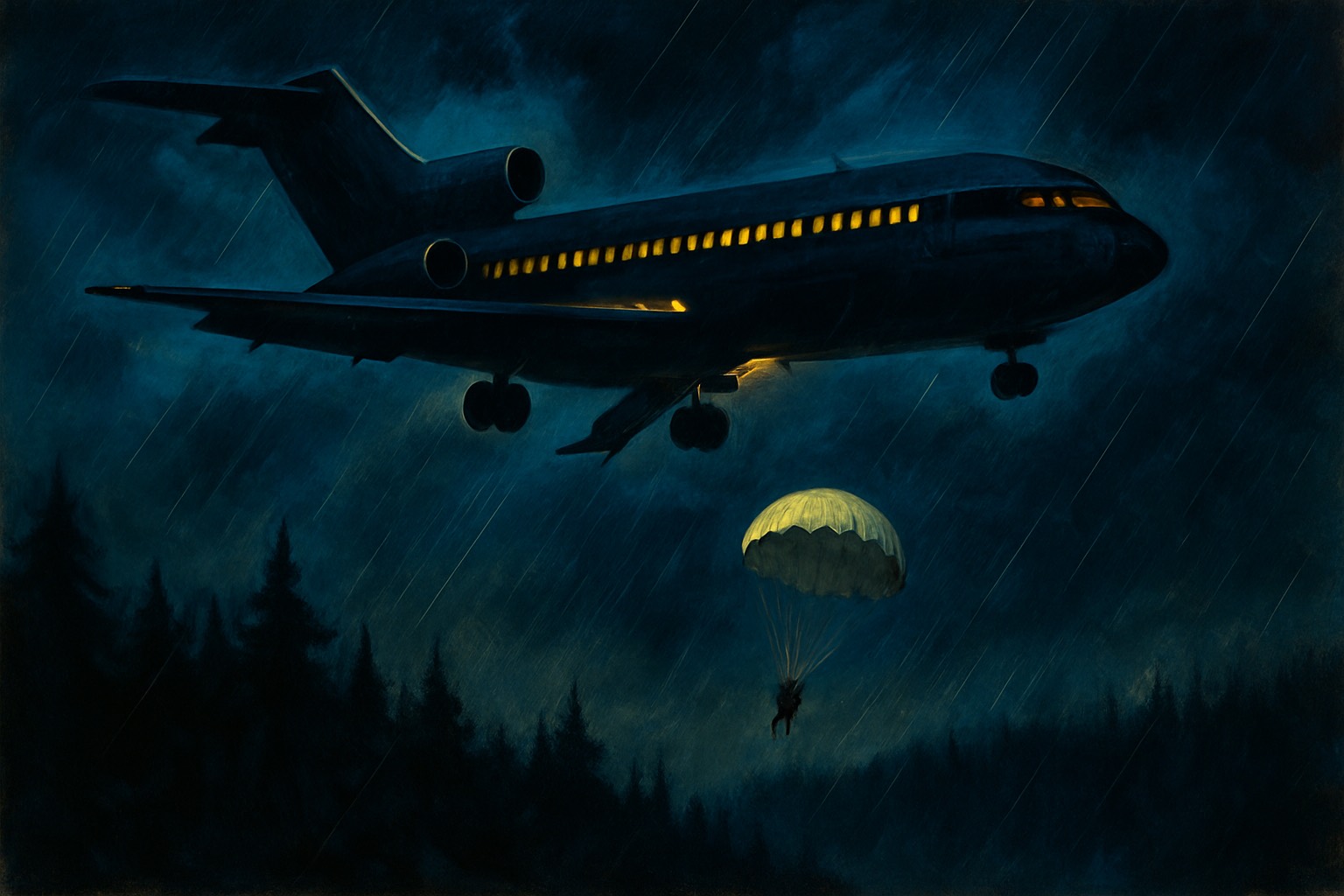
The man bought a one-way ticket for twenty dollars, ordered a bourbon and soda, and gave his name as Dan Cooper.
On the afternoon of November 24, 1971 — the day before Thanksgiving — a quiet, middle-aged man in a dark business suit boarded Northwest Orient Airlines Flight 305 in Portland, Oregon, a short hop north to Seattle. Somewhere over the Pacific Northwest he handed a flight attendant a note, told her he had a bomb, and opened a briefcase to show her a tangle of wires and red cylinders. He asked for $200,000 in cash and four parachutes. A few hours later, over the rain-soaked forests of southwestern Washington, he lowered the aircraft's rear stairs, stepped into the freezing dark, and was never seen again. It remains the only unsolved act of air piracy in the history of American commercial aviation.
The Mystery
The flight was routine until it wasn't. The Boeing 727-100 was an unremarkable short-haul jet, and Cooper was an unremarkable passenger — witnesses later described a man in his mid-forties, dark-haired, brown-eyed, wearing a business suit, a white shirt, and a thin black tie. He was calm. He smoked. He was, by every account, polite.
The note he passed to flight attendant Florence Schaffner was, at first, nearly ignored — she assumed a lonely businessman was slipping her his phone number and tucked it into her purse unread. Cooper leaned over and told her quietly that she should look at it: he had a bomb. Inside the briefcase on his lap was a bundle of wires and what appeared to be red sticks. His demands were specific and clinical — $200,000 in twenty-dollar bills, four parachutes, and a fuel truck standing by in Seattle.
The airline complied. When Flight 305 landed at Seattle-Tacoma, the passengers — none of whom realized anything was wrong — were released in exchange for the cash and the parachutes. Cooper kept the crew aboard. He then issued a second set of instructions that revealed real knowledge of aircraft: refuel, and fly south toward Mexico City at low altitude and reduced speed, landing gear down, flaps at a specific setting, cabin unpressurized. He had effectively ordered the crew to configure the 727 for a parachute jump.
The 727 had a feature few aircraft shared: a hinged stairway under the tail that could be lowered in flight. Sometime after 8:00 p.m., as the jet flew through rain and cold somewhere over the wilderness between Seattle and Reno, Nevada, a warning light in the cockpit indicated the aft airstair had been deployed. The crew, sealed in the cockpit, felt a slight upward bump in the tail. When the plane landed in Reno, the stairs were down, Cooper was gone, and so was the money. He had vanished into one of the most rugged and sparsely populated stretches of the Pacific Northwest, at night, in a storm, in a business suit, with a parachute and a bag of cash strapped to his body.
What Josh Gates Found
The D.B. Cooper case sits at the center of the Expedition Unknown sensibility — a genuine, documented mystery with a paper trail and physical evidence, not a campfire legend. The appeal for a field investigator is obvious: this is not a question of whether something happened, but of where a man and his money actually came down.
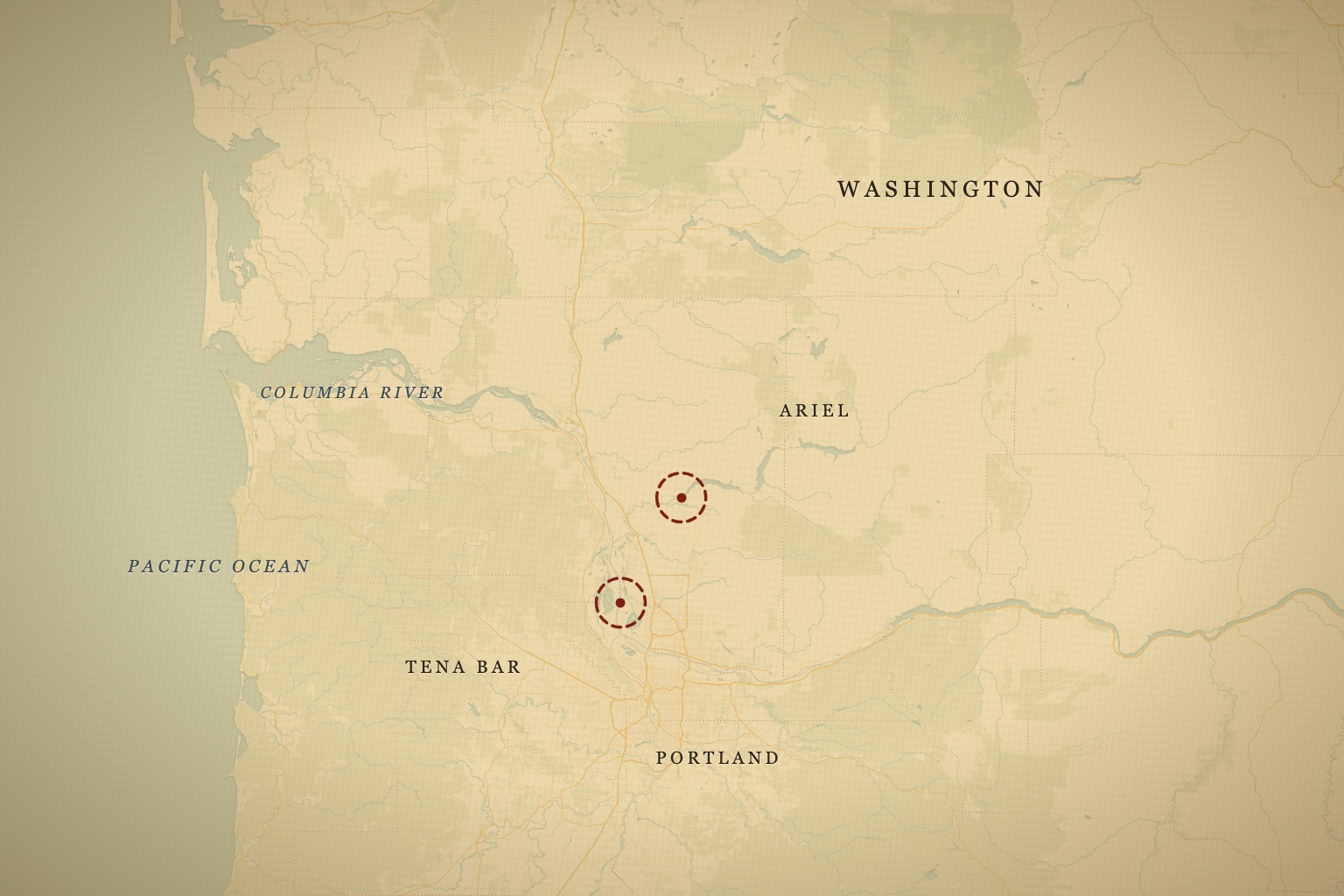
The investigation has always orbited two unknowns: the drop zone and the identity. The FBI's original calculations — based on the aircraft's flight path, speed, and the moment the airstair light illuminated — pointed to a wooded drop zone in the vicinity of the Lewis River, north of Portland, near the towns of Ariel and Amboy, Washington. But the variables are punishing. A small error in timing, a shift in wind, a gust at altitude — any of it moves the landing point by miles across terrain that is heavily forested, steep, and in places nearly impenetrable. Searchers combed it for weeks in late 1971 and found nothing: no parachute, no briefcase, no body, no money.
The single most important physical break in the case came years later and miles away. In February 1980, an eight-year-old boy named Brian Ingram, raking a sandy riverbank for a family campfire at a spot called Tena Bar on the Columbia River — roughly ten miles northwest of Vancouver, Washington — uncovered three deteriorating bundles of twenty-dollar bills bound with rubber bands, about $5,800 in all. The serial numbers matched the ransom. FBI agents returned to the site and recovered additional fragments, some reduced to scraps the size of coins, then brought in a backhoe and specialists in soil, river current, and archaeology to work the bar. No intact bills beyond Ingram's find ever turned up.
It was, and remains, the only piece of the ransom ever recovered, and rather than solving anything, it deepened the puzzle. Tena Bar sits well downstream and to the west of the calculated drop zone, raising the question of how Cooper's money traveled there at all — washed down by the river, buried deliberately, or carried by a hand that was never Cooper's. Each theory runs into a wall. The way the bills were layered in the sand, and the condition of the rubber bands after years in the ground, has been argued by investigators to be inconsistent with a simple, gradual river deposit — but no alternative has ever been proven either. The find that should have been a thread to pull turned out to be a knot.
What History Says
The FBI investigation — codenamed NORJAK — became one of the longest and most exhaustive in the Bureau's history. Over the decades agents evaluated more than a thousand suspects. None could ever be conclusively tied to the crime, and the few who came closest were eventually weakened by alibis, DNA mismatches, or simple lack of evidence.
The physical record is frustratingly thin and frustratingly suggestive in equal measure. Cooper left behind his clip-on tie on the aircraft, along with the tie clip — items that decades later yielded particles examined by researchers hoping that traces of metals or other materials might point to his occupation. He left behind cigarette butts, later lost from FBI custody. He left behind the descriptions of the crew, two composite sketches, and the parachutes he didn't use. What he did not leave behind was a body, which fed two enduring and opposed conclusions.
The skeptical reading is that Cooper almost certainly died. He jumped into a freezing, stormy night over mountainous wilderness, in a business suit and loafers, into roughly 200-mile-per-hour wind at the open airstair, with no helmet, no jump boots, and no clear sense of what lay below him in the dark. Among the four parachutes he was handed, investigators noted, was a reserve chute that had been sewn shut for training use and could not have opened — a detail suggesting Cooper either didn't know enough to check or didn't care which canopies he took. The odds of surviving the jump, let alone the exposure and the terrain afterward, were grim. By this logic, his remains and most of his money have simply never been found, scattered somewhere under the rain and timber of the Cascade foothills.
There is also a long-running debate about how much of an expert Cooper really was. He clearly knew the 727 could be jumped from in flight, and he knew how to ask the crew to slow and configure it. But he chose a stormy night, a rear exit into brutal wind, and gear he didn't fully vet — choices a seasoned paratrooper might have avoided. Investigators have swung between two portraits over the years: a meticulous professional who planned everything, and a desperate amateur who got the broad strokes right and gambled on the rest. The evidence supports neither cleanly.
The opposing reading points to the absence of evidence: in more than five decades, no body, no parachute, and almost none of the cash has surfaced — an odd outcome if Cooper died on impact in a defined search area. The Tena Bar money find, geologically puzzling and chemically strange after years in the soil, has been used to argue both that the river carried it there naturally and that someone placed it. The case became formally inactive in 2016, when the FBI redirected its resources, while leaving the ultimate questions open.
The Verdict
Fifty-five years on, almost nothing is settled. We do not know who Dan Cooper was — the persistent "D.B." is a reporting error that stuck, not a name he ever gave. We do not know where he landed, whether he survived, or how a fraction of his ransom ended up half-buried on a Columbia River sandbar. The man hijacked a jet, extracted a fortune, jumped into the night, and left behind only a tie, a stack of serial numbers, and a question.
That open-endedness is exactly why the case refuses to die. It is solvable in principle — there was a real man, a real drop zone, a real bag of money — and unsolved in fact. The wilderness north of Portland is still there. So is Tena Bar. If you want to stand where the only physical clue surfaced, the riverbank is real ground you can walk, and the foothills the FBI once searched are still keeping whatever they were ever given. The file is suspended, not closed — and the difference is the whole story.
> Update — July 2026: The case picked up three new threads in 2025. FBI files released that year show the tie's particle count grew from roughly 700 microscopic particles to more than 100,000, including unalloyed titanium, bismuth, and strontium sulfide — materials pointing to specialized aerospace, chemical, or electronics manufacturing, with speculation of a Boeing connection. A parallel track put a name back at the center of the case: Richard Floyd McCoy Jr., an Army veteran and pilot who pulled off a nearly identical hijacking five months after Cooper, in April 1972, and whom the FBI seriously investigated at the time. In 2022, an investigator working with McCoy's adult children turned up a parachute and skydiving logbook on the family's North Carolina property, showing jumps in the same Oregon/Utah terrain — evidence serious enough that the FBI seized the parachute for DNA testing against the partial profile recovered from Cooper's tie. Only 7 of the 23 markers needed for a match were recoverable, and the Bureau quietly returned the parachute in December 2025 without a ruling. Discovery's Expedition Files ("Lost and Found," Season 2, Episode 6, aired May 2025) revisited the case with a third open question: Josh Gates and the team propose a new drop zone north of Reno, Nevada, arguing the terrain there fits the jump physics better than the FBI's original search area in the Washington timber. None of it closes the file. It reopens three of them at once.
Covered On Screen
- Cracking the D.B. Cooper CaseExpedition Unknown · S3 E7
- Ransom in the SkyExpedition Unknown · S9 E3
Explore the sites mentioned in this post on the interactive map.
Open the Tracker